Space and Physics
 PUBLISHED


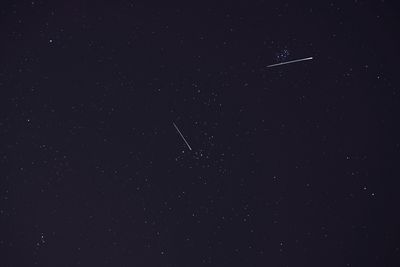


A pair of showers is triggered by the Earth passing through a meteoroid stream left behind by Comet Encke. These are the Southern Taurid and Northern Taurid showers, named because their path origin appears to begin in the constellation Taurus.
You can spot this constellation and the meteor sparks in the eastern sky in the hours before midnight during October.
The Northern Taurid showers are most active on the night of November 11-12, but will be active between October 20 and December 10. The Southern Taurid showers peaked earlier on October 10, but will be active until November 20.
These meteors should appear at a sparse rate of roughly five per hour. You might not see many of these meteors from your sky watching perch, but when they do flare into view, they are big and bright.
Also known as Halloween fireballs, Taurids are relatively slow meteors (although they still move at 65,000 miles per hour). This year, viewers will have to contend with natural light pollution from the moon on the peak days of both the Northern and Southern Taurids.
The best advice for watching the stars comes from the Royal Museums Greenwich. They say you should identify a dark sky region with clear views to the south. Give your eyes plenty of time to get used to the dark. Binoculars or telescopes won’t help you spot meteors and may even restrict your peripheral view.
Once you are acclimatized, it’s time to find the Taurids. Look first for Orion’s belt. Up and right from the belt is a bright orange star called Aldebaran. This star is one of the eyes in Taurus’s bull. The most spectacular Taurids will appear around Taurus, so keep tracking around this corner of the night sky to spot these dramatic night lights.
Meteor showers are seen when the Earth flies through trails of comet debris, which incinerate dramatically in the friction of our planet’s atmosphere.
Comet Encke was first recorded in 1786 by French astronomer Pierre Méchain. Despite his contribution, the comet wasn’t named after Méchain, as it was only in 1819 that German astronomer Johann Franz Encke realized that numerous subsequent comet sightings were of the same heavenly object. Encke detailed the comet’s path— a journey across the sky in an orbit around the sun that lasts 3.3 years.
Both Comet Encke and the Taurids are thought to be remnants of a larger, ancient comet that has slowly been disintegrating over the past 20,000 to 30,000 years.