Space and Physics
 PUBLISHED


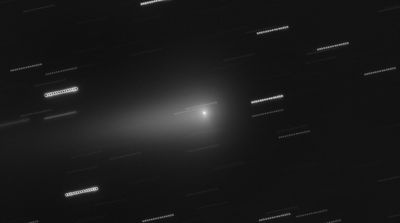


Interstellar comet 3I/ATLAS is special. From the earliest observations, its peculiarity was obvious, and the many observations since have continued to not just support that hypothesis but also to expand the reasons why this celestial interloper is unique.
Observations using the ALMA observatory, which studies the universe in millimeter light, and JWST, whose focus is infrared, have already suggested that the comet came from the cold regions around an ancient star. The age of the comet was also already suggested as ancient when we spoke to the researchers who first calculated its age, mere days after the discovery.
Now the European Southern Observatory’s Very Large Telescope (VLT) has provided its insights and concluded that the interstellar visitor formed on the outskirts of a low-metallicity star much older than our own.
Astronomers measured the isotopic ratio of carbon and nitrogen in the comet. Elements have different isotopes, basically versions of themselves that have more or less neutrons in the nucleus, while the number of protons stays the same.
It's really exciting because we are getting to see a little bit of other planetary systems.
Dr Cyrielle Opitom
Let’s take carbon, for example. Its more common variety is carbon-12, with 6 protons and 6 neutrons in its core. But among the isotopes there is also carbon-13, which still has 6 protons (it wouldn't be carbon otherwise) but 7 neutrons.
Similarly, nitrogen has 7 protons and can come in versions such as nitrogen-14 and nitrogen-15.
“We measured isotopic ratios of carbon and nitrogen, and what we found is both of them being higher than what we see for Solar System comets,” lead author Dr Cyrielle Opitom, from the University of Edinburgh, told IFLScience.
The formation of carbon-13, which is a rare isotope, is linked to stars that are chemically simpler than our Sun. Those are stars that formed before our own. The nitrogen isotopic ratio suggests that it formed a lot farther out from its star, as such a ratio is a distance-from-the-star indicator.
“Those measurements altogether mean that it at least probably indicates that 3I Atlas comes from a more ancient star than the Sun, an older star than the Sun,” Opitom told IFLScience, “not a star that has a longer life but that was formed before.”
The ratios are much higher than what has been seen for Solar System comets, placing this object in a category of its own. Everything so far seems to indicate that 3I/ATLAS is certainly older than the Solar System and, if other studies have to be believed, could be up to 12 billion years old.
It is also in a category of its own when it comes to the other two interstellar objects, 1I/’Oumuamua, discovered in 2017, and comet 2I/Borisov. The first one did not outgas, and the second one was too faint to have its isotopic ratio studied. 3I/ATLAS is a unique window on another star system that might not even exist anymore.
"It's really exciting because we are getting to see a little bit of other planetary systems,” Opitom told IFLScience.
The study is published in the journal Nature Astronomy.