Space and Physics
 PUBLISHED





On Tuesday, NASA astronauts Reid Wiseman, Victor Glover, and Christina Koch, along with Canadian Space Agency astronaut Jeremy Hansen, launched towards the Moon on Artemis II.
The 10-day journey will take them further beyond our natural satellite than any prior mission – letting them see parts of the far side of the Moon no human has directly seen before. And we can follow the entire process thanks to NASA's very handy tracking system.
At 7:49 pm EDT on Thursday 2 April, the astronauts began their trans-lunar injection burn – a 5-minute-50-second blast of the main engine – so they are no longer in orbit around Earth. Glover is the first Black person and Koch is the first woman to get this far from our planet.
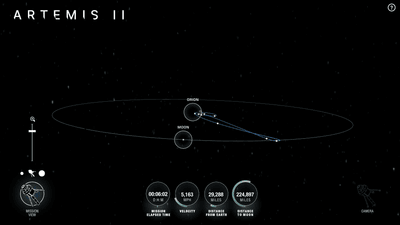
The thing we like the most about the tracking system, called the Artemis Real-time Orbit Website (AROW), is you can clearly see that the Orion spacecraft is currently not going directly towards the Moon.
The visualization shows where the Moon is right now, tens of thousands of kilometers away, but Orion is actually going towards where it will be in a few days’ time, at which point the craft will enter lunar space and go around our natural satellite.
Accessing the tool is possible both through its dedicated website and the NASA app. The mobile version of AROW even has an augmented reality function – so you can see around Orion as if you were truly near the spacecraft.
There is also a more old-school approach to following Artemis II – using a telescope and NASA’s official ephemeris: a table of data with the position, velocities, and trajectories of the Orion spacecraft. You can download it from the NASA website.
To be truly old school, you can do it by hand, but many modern telescopes allow you to just download the ephemerides of celestial bodies and artificial objects, allowing it to point at the object in question without the need for you to work out the correct celestial position with respect to your terrestrial one.
Artemis II is a historic mission for NASA. It’s the first human-crewed flight to deep space and around the Moon since Apollo 17 in 1972. And the space agency has big plans for the Artemis program, though these have changed a lot of the past few years, and even just recently.
Next year, Artemis III is scheduled to perform test activities in low Earth orbit with either one or both of two competing privately constructed lunar landers, SpaceX’s Starship and Blue Origin’s Blue Moon. Questions remain if they will be ready on time.
In 2028, the agency hopes to have two Moon landings with Artemis IV and Artemis V. At the same time, NASA intends to deliver the initial building blocks of its proposed lunar base.