Nature
 PUBLISHED
 3
3


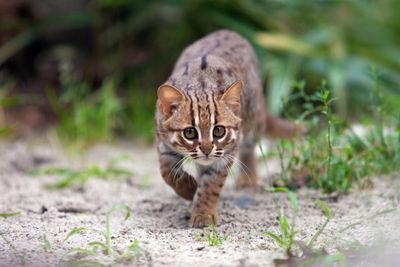


A brand new species of cat has been found in a fossil from a cave in China. Reportedly small enough to have fit in the palm of your hand, the cat – named Prionailurus kurteni – is thought to have coexisted alongside ancient people.
Prionailurus kurteni was discovered from a fragment of jaw bone in Hualongdong Cave and is believed to be between 275,000 and 331,000 years old. It is also thought to belong to the broader group known as the leopard cats, of which several species still survive today.
The team believes that the new species "represents the smallest known fossil member of the family Felidae to date" and is comparable, though potentially even smaller than, living species such as the rusty-spotted cat (Prionailurus rubiginosus) and the black-footed cat (Felis nigripes), which are some of the smallest extant members of the Felidae family.
"This cat is clearly smaller than a domestic cat. It is comparable to the smallest living cat, [at around] 1 kilogram [2.2 pounds]," lead author Qigao Jiangzuo, told Live Science.
Finding cat fossils in this area is rare because the bones are often small and fragile and are not preserved well. Most previously discovered fossils, including this one, come from dentition or jaw bones, which makes identifying the species and its relationships tricky.
However, Hualongdong Cave is something of a hot spot; it has been the source of a variety of fossils featured in previous studies. The cave contained the remains of ancient humans, brown bears, and lots of arvicolids – a group containing lemmings, species of voles, and muskrats. The presence of these additional fossils led the team to believe that the area was colder than other similar locations in south China, and also to speculate about the relationship between the new cat species and the ancient humans that lived there.
"The food scraps these archaic humans left at the Hualongdong site might have attracted rats and small leopard cats as well," Jiangzuo told China Daily. "It's unclear whether these cats constituted part of the cave dwellers' diet, due to the absence of butchery marks on the fossils," he added.
The angle of one of the teeth also suggests that this new species could provide a link between the leopard cats and the common ancestors of the domestic cat, as well as the famously grumpy-looking Pallas’s cat (Otocolobus manul).
"We plan to systematically survey the fossil cats in China and around the world, which were not well studied in the past. We hope to trace the origins and past diversity of the cat family,” Jiangzuo told Live Science.
The study is published in Annales Zoologici Fennic.