Nature
 PUBLISHED


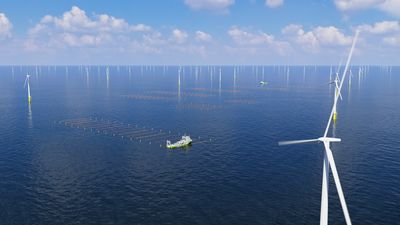


In a super-green offensive against carbon emissions, the world's first commercial seaweed farm inside a wind farm is slated to open off the coast of the Netherlands.
The pioneering aquaculture plot will be located within Hollandse Kust Zuid (HKZ), a set of 139 wind turbines in the North Sea around 18 kilometers (11 miles) away from The Hague and Zandvoort.
Set to start operating this fall, the farm will cover 5 hectares (12.4 acres) and is expected to produce at least 6,000 kilograms (13,227 pounds) of fresh seaweed in its first year.
It's the brainchild of North Sea Farmers, a Dutch non-profit group, who set up the project with the help of €1.5 million ($1.67 million) funding from Amazon’s Right Now Climate Fund.
The ethos behind the North Sea farm is brimming with big ideas. Growing seaweed is an easy way to suck up carbon dioxide and remove it from the atmosphere, thereby addressing the problem of climate change. Data from the project will be used by scientists to help further research on carbon reduction through seaweed cultivation.
"We are excited that North Sea Farm 1 is on the verge of becoming a fully operational seaweed farm. We look forward to gaining more insights into the potential of seaweed to remove carbon dioxide from the atmosphere through the scientific research that North Sea Farmers, Plymouth Marine Laboratory, and their partners will conduct," Roeland Donker, Country Manager of Amazon Netherlands, said in a statement.

“The integration of seaweed cultivation with offshore wind farms offers an opportunity to resolve space constraints for the seaweed sector in coastal areas, with additional potential for atmospheric CO2 uptake. Our aim is to understand how this sector could be used for long-term carbon sequestration, which is still poorly understood,” Professor Ana Queirós, Marine and Climate Change Ecologist at Plymouth Marine Laboratory and scientific lead, said in another statement.
Seaweed is an incredibly nutritious (and often delicious) food. Along with containing basic carbohydrates, proteins, and fats, it’s also loaded with nutrients like magnesium, zinc, vitamin B12, iodine, and polyunsaturated fatty acids, as well as antioxidants like carotenoids and flavonoids.
What's more, it has a variety of other useful applications, from packaging and animal feed to cosmetic products and pharmaceuticals.
Demand for this undervalued plant is set to skyrocket in Europe over the coming years. A 2021 report by the UK’s Seaweed for Europe argued that the expanding seaweed market in Europe could be worth €9 billion (around $10 billion) by 2030, create 115,000 jobs, and deliver significant health benefits to the population.
"HKZ is one of the newest wind farms in the North Sea and is relatively close to the coast. With a two-hour boat trip, we can show our stakeholders how a seaweed farm can be integrated into an offshore wind farm. We hope this project will further convince people of the scaling opportunities in the North Sea with seaweed and other forms of multi-use," noted Eef Brouwers, General Manager of North Sea Farmers.