Nature
 PUBLISHED
 2
2




US national parks are famed for their biodiversity, but even the most well-studied of places can still throw us a surprise or two. In 2024, Big Bend National Park in Texas presented a particularly rare one – the first new plant genus and species to have been discovered in a US national park since 1976.
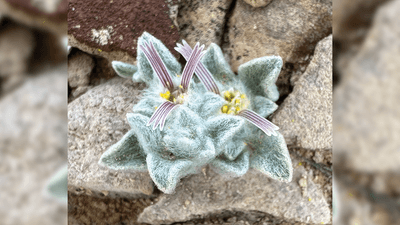
The new species has been given the suggested common name the “wooly devil”: the “wooly” part after its fuzzy appearance, and “devil” after its two red ray florets resembling horns and its closeness to an area known as the Devil’s Den.
Its scientific name, Ovicula biradiata, leans into similar themes. Ovicula stems from the Latin word for “tiny sheep”; that makes sense given its fluffiness, but also because Big Bend is home to the iconic ovine that is the desert bighorn sheep. Biradiata, on the other hand, means biradial, referring to its two almost symmetrical ray florets.
The plant was first spotted in the park’s hot desert landscape in March last year by park volunteer Deb Manley, who uploaded photos of it to iNaturalist. It caught the interest of a team of botanists, who were granted permission by park authorities to collect more specimens.
Studying the plant, they determined it to be something quite unexpected just by looking at it – a sunflower.

“O. biradiata is a member of the sunflower family, although it does not resemble its sunburst-shaped relatives at first glance,” said Dr Isaac Lichter Marck, the corresponding author of the study describing the new species, in a statement.
The ecologist isn’t wrong – take a quick look at the wooly devil and it looks like somebody tried to make a flower out of fluffy cactus parts. Appearances can be deceiving, however, which is when genetics can come in handy.
“After sequencing its DNA and comparing it with other specimens in the [California Academy of Science’s] herbarium, we discovered that this small, fuzzy plant is not only a new species within the sunflower group, but it is also distinct enough from its closest relatives to warrant an entirely new genus,” explained Lichter Marck.
The last time a new plant genus was documented in a US national park was nearly 50 years ago, when the July gold (Dedeckera eurekensis) shrub was discovered in Death Valley National Park.
But while the wooly devil has only recently been uncovered, there’s a chance that it might already be in danger of disappearing.
“As climate change pushes deserts to become hotter and drier, highly specialized plants like the wooly devil face extinction,” said Lichter Mark. “We have only observed this plant in three narrow locations across the northernmost corner of the park, and it’s possible that we’ve documented a species that is already on its way out.”
That’s why the exact location of the wooly devil is being kept a secret, giving the team time to further study the plant in order to figure out if it should be listed under the Endangered Species Act.
Ensuring the plant sticks around is important for multiple reasons, but in particular, the team notes there’s a chance that the wooly devil might have medicinal properties.
“Under the microscope, we noticed specific glands that are known to possess compounds with anti-cancer and anti-inflammatory properties in other plants within the sunflower family,” said co-author Keily Peralta.
“While further research is needed to determine these properties, this discovery underscores the potential knowledge we stand to gain from preserving plant diversity in fragile desert ecosystems.”
The study is published in PhytoKeys.