Nature
 PUBLISHED

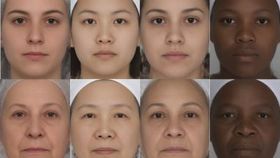


Next time you get IDed, you can thank your youthful coloring. An international team of researchers found that decreased facial contrast (the degree to which your facial features stand out in the face) is a sign of aging – and this is the case for women across all ethnic backgrounds. The results have been published in the journal Frontiers in Psychology.
When we're younger, our eyes, lips, and eyebrows tend to be more distinctive in terms of coloring. Therefore, women with increased facial contrast are perceived to be more youthful.
"Facial contrast refers to how much the eyes, lips, and eyebrows stand out in the face in terms of how light or dark they are or how colorful they are," said Aurélie Porcheron, one of the study's authors, in a statement.
This is not the first time a study has shown that greater facial contrast indicates better health, youthfulness, and even feminity, note the researchers. It is, however, unlike most previous studies, which have primarily focused on Caucasian faces or Caucasian observers. Here, the French-American team analyzed the correlation between aging and facial contrast across different ethnicities.
The researchers proposed that the relationship between facial contrast and aging would be the same across all ethnicities. This is because age-related changes in skin coloring are very similar among all groups, even when there is a huge variation in skin color.
First, the team analyzed photographs of 763 women of Chinese, Latin American, South African, and French Caucasian origins, all aged between 20 and 80, using computer software. The team noted some small differences but found that many indicators of facial contrast appear to be universal signs of aging. Take, for example, the luminance contrast around the eyes or the green to red coloring around the mouth. This suggests that facial contrast is a biological marker of age in humans of all ethnicities.
The next step was to test if and how individuals from different ethnicities recognized this sign. The researchers picked photographs from women of different ethnic backgrounds and ages and used computer software to create two different images of each woman. One would show high facial contrast, whilst the other showed low facial contrast. Men and women from China and France were asked to select the younger looking face from the two options and eight out of ten times they picked the picture with higher facial contrast. This suggests that skin coloring and facial contrast is a cross-cultural cue for perceiving age.
"The results also suggest that people could actively modify how old they look, by altering how much their facial features stand out, for example by darkening or coloring their features," Porcheron explained.