Nature
 PUBLISHED
 1
1


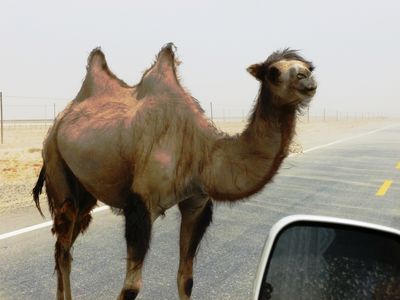


Camels are magnificently weird, perfectly adapted to the harsh life of deserts where water is scarce and dehydration is a very real threat. And none are more remarkable than the wild Bactrian camel (Camelus ferus), which can survive on water saltier than seawater.
In their native habitat of northwest China and southwest Mongolia, these humped mammals can be seen happily drinking from saltwater springs. Scientists are not sure how, but they’re able to tolerate salinity levels that would quickly dehydrate or poison most other large animals.
Humans, by contrast, cannot drink water with high salt content. When we ingest water saltier than seawater, the kidneys cannot excrete the excess salt fast enough. The high sodium levels in the blood pull water out of cells through osmosis, causing cellular dehydration, stress, and potentially life-threatening electrolyte imbalances. The wild Bactrian camel, however, has somehow evolved a renal system capable of handling these extreme conditions.
This species is not to be confused with the many domesticated camels found across Asia and North Africa – don’t try quenching their thirst with seawater. Humans have never domesticated the wild Bactrian camel, and it's genetically distinct from all other camel species. Their closest relative is the Bactrian camel (Camelus bactrianus), a shaggy cousin used as a pack animal in Inner Asia.
They’re particularly associated with a region known as Lop Nur in the northern Chinese province of Xinjiang. This desert landscape was used for testing nuclear weapons between 1955 and 1996, which boded well for the wild camels (provided they weren’t in the blast zone) because it meant it was largely devoid of humans. Since nuclear tests have stopped, the threat of humans has reemerged. As such, they're currently listed as an endangered species on the IUCN Red List.
“The remoteness of the area has helped preserve them. But with the cessation of nuclear tests, illegal hunters and miners looking for gold and iron ore are moving in. We found land mines put by the salt water springs,” John Hare, founder of the UK-based Wild Camel Protection Foundation, said in 2001, according to BBC News.
"So when the camels come to drink, they step on them - bang! They are blown to pieces and picked up as meat."
Saltwater sipping isn’t their only adaptation to extreme conditions. The camel genus has unique oval-shaped red blood cells that make them highly resistant to osmotic stress, allowing them to endure extreme dehydration and rapidly rehydrate without cell rupture.
Of course, they also have their humps. It’s a common myth that they store water; they’re actually packed with fatty tissue that is used as an emergency food source. They’re essentially a bulging belly of fat on their backs, not a water storage tank.
They can, however, guzzle and process huge amounts of liquid. A typical camel can drink up to 200 liters of water in three minutes, a feat that would put any beer-chugging frat boy to shame.