Humans


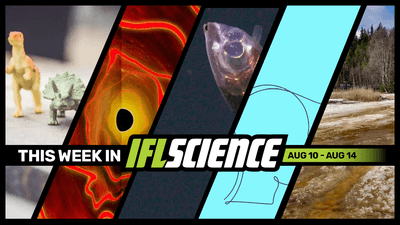


This week, scientists have discovered a brand new object at the end of the universe and dubbed it a “black hole star”, a fish with a see-through head has been filmed 710 meters below the sea for the first time, and we asked the experts what they think about the sweeping moral panic surrounding ADHD diagnoses. Finally, we spoke to Chris Carter, creator of The X-Files, about how he was inspired by real-life head transplants.
Create an IFLScience account to get all the biggest science news delivered straight to your inbox every Wednesday and Saturday.
Why Were There No Mouse-Sized Dinosaurs? New Model Suggests Our Distant Mammalian Ancestors Are To Blame
Think of a dinosaur. Was it a mighty T. rex? A towering sauropod? Or maybe something a little smaller? These prehistoric beasties reached uniquely large maximum sizes, but (modern birds aside) they never seemed to get all that small. Dinosaurs the size of a mouse or a rat just don't crop up all that much in the fossil record. Why not? Read the full story here
We’ve Just Discovered A Brand New Object At The End Of The Universe – Meet A “Black Hole Star”
A survey using the space telescope JWST has found evidence of a peculiar star-like quality in a black hole from the early universe, leading researchers to suspect they are looking at a brand-new type of astrophysical object: a black hole encased in a ball of hydrogen that makes it appear like a giant star, or a "black hole star". Read the full story here
Watch The First-Ever Footage Of A Fish With A See-Through Head Filmed In The Twilight Zone, 710 Meters Below The Sea
There exists a place on Earth where life gets so weird you would think you were swimming with aliens. In the Twilight Zone, where almost no sunlight can reach, living organisms have adapted to life in the dark by evolving all sorts of weird body plans. For the first time, one of these weirdos has been filmed alive. Read the full story here
Overdiagnosed? Over-Treated? Completely Made Up? What Experts Think About ADHD, And The Moral Panic Sweeping The Nation
ADHD is, it seems, having a moment. Or, if not the condition itself, then at least its deniers: headlines and TV shows abound with claims that ADHD is “overdiagnosed”, or “over-treated” or, in some cases, just plain not a real thing at all. It’s enough to make anybody panic – but, for experts, the reason is probably not what you’re expecting. Read the full story here
Highs Of 35°C In Siberia: Temperatures In The Arctic Circle Have Been Getting A Little Out Of Hand
It's getting pretty hot in the Arctic right now. This July ranked as the third highest overall for Arctic surface temperatures since 1950. Over the course of last month, more than 70 percent of the land and sea north of 60°N was warmer than the 1991-2020 baseline, and 12 percent of the region had one of its top three warmest Julys. The highest temperatures were in Russia, with the middle Lena Valley in eastern Siberia topping 35°C (95°F) on July 9 and 10. Read the full story here
TWIS is published weekly on our Linkedin page, join us there for even more content.
Feature of the week:
X-Files Creator Chris Carter On How Real-Life Head Transplants Inspired The Show’s Scariest Movie
For many people, The X-Files' monster-of-the-week episodes were their favorites. In the second movie, The X-Files: I Want To Believe, we got a whole two-hour standalone thriller that tells a grisly tale of murder, organ thefts, and head and body transplants. You may be surprised to discover that real-life scientific head and body experiments inspired show creator Chris Carter to make the movie. IFLScience chatted to Carter ahead of the director's cut released this week about how this is the gruesome version of the movie he wanted to release all along. Read the full story here
More content:
Have you seen our e-magazine, CURIOUS? Issue 49, August 2026, is available now. This month, we asked, “How Do Animals Get Their Patterns?” – check it out for exclusive interviews, book excerpts, long reads, and more.
PLUS, the We Have Questions podcast – an audio version of our coveted CURIOUS e-magazine column – continues. In episode 23, we ask, “Why Do 8 Million Pickled Fish Sit In Louisiana's WWII Bunkers?”
The Big Questions podcast season 6 continues with episode 5, where we ask, “Can AI Be Conscious?” Host Dr Alfredo Carpineti sat down with Dr Alex Hanna, sociologist and director of research at the Distributed AI Research Institute, to talk about the big claims surrounding these computational approaches.


 1
1