Space and Physics
 PUBLISHED


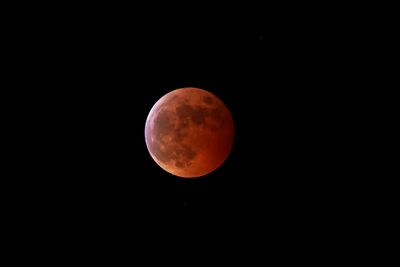


Tomorrow night or morning, depending on your location, the Moon will turn red for half the world. For those who miss it, however, there is an unusually long wait for the next one.
Anyone reading this has lived through quite a few lunar eclipses, and hopefully will live to see many more. Nevertheless, there are a few good reasons to check out this one if you live in the Americans, Australia or most of Asia.
Firstly, every lunar eclipse is different. Sometimes the Moon turns a deep and eerie red, while others are more of a light pink, depending on how deep into the Earth’s shadow the Moon passes and the state of our atmosphere. On top of that, as we have already noted, this eclipse is special, because much of the world will have such an impressive parade of planets accompanying it.
There’s one more reason to check this lunar eclipse out – if you miss it, you’ll be waiting an unusually long time for another chance.
Somewhat counter-intuitively, total lunar eclipses are rarer than their solar equivalent. However, unless you’re willing to fly an awful lot, you’ll get to see many more of them in your life.
That’s because a total solar eclipse is only visible within a thin strip of territory, because the Moon is smaller than the Earth, and at this distance its shadow is almost gone. Miss a solar eclipse at your location and you’re likely to have to wait centuries before another one comes to you.
On the other hand, when the Moon passes into Earth’s shadow, literally half the planet can see the change of color (or could if clouds didn’t delight in blocking the keenest observers’ view.)
On average, there is a little less than six months between lunar eclipses. Even allowing for the fact half the world misses each, that’s still roughly one where you are a year. Take out the ones you lose to cloud cover, and the “can’t be bothered getting up at 4am” factor, and you could see a lunar eclipse every two years or so without needing to travel.
There’s just one problem. The paragraph above refers to lunar eclipses, not total lunar eclipses. A partial eclipse occurs when the Moon does not pass fully through the Earth’s umbra, the deep shadow where the Sun is entirely blocked. Therefore, at least part of its surface is receiving light not bent and colored by passing through Earth’s atmosphere. Worse, in a penumbral lunar eclipse, no part of the Moon sees a fully blocked Sun; instead, it just appears the Earth took a chunk out of it.
While even many eclipse enthusiasts regard partial solar eclipses as a waste of time, since you don’t get to see the solar corona and pink streamers, partial lunar eclipses can have a bit more to offer. A partial eclipse still shows the curve of the Earth’s shadow on the Moon, to the continuing annoyance of flat Earthers. In a deep partial eclipse, you also get some of the color change, because the Moon is receiving more sunlight filtered by the atmosphere than is arriving directly unfiltered.
Still, it’s not a complete substitute for a total eclipse, a bit like the difference between being dead and mostly dead.
The size of the Earth’s shadow relative to the Moon is large enough that usually, when at least part of the Moon goes through the umbra, all of it does at some point. Consequently, more than a third of lunar eclipses are total, more than the number of partials.
Despite this, sometimes you get a run of partial lunar eclipses between two full ones, and the next six are all partial or penumbral.
Looking at this intervening set shows how much eclipses can vary. On January 12, 2028, less than 7 percent of the Moon will be completely eclipsed. That’s still better than the penumbral eclipses of February, July, and August 2027, when none of the Moon will be fully eclipsed, part of it will have some of the Sun’s light blocked, and some will experience no eclipse at all. On the other hand, the partial eclipse of August 28 this year will be about as close to a total lunar eclipse as you can get without having the real thing, with 93 percent of the Moon entirely in the Earth’s shadow at peak.
To make up for this gap, the next total lunar eclipse has some awesome timing, being on New Year’s Eve, or New Year’s morning, again depending on where you are in the world, in 2028. It will be visible over Asia, Australia, and some of Europe and Africa to ensure maximum visibility – in many places right as the year changes. It’s the first New Year’s Eve total lunar eclipse since the modern calendar created New Year’s Eves, although surprisingly, the next one is less than 20 years away.
Once the total eclipses start again, they do so with gusto. In June 2029, we get the deepest eclipse of the 21st century, with the Moon not far from the closest point in its orbit passing almost dead center through the Earth’s shadow. There’s also another total lunar eclipse in December 2029.