Space and Physics
 PUBLISHED


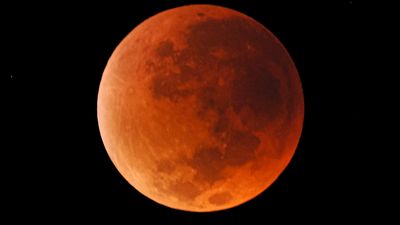


The beginning of March comes with a host of exciting things to look at in the night sky. There will be a total eclipse of the Moon, a planetary parade, and even a planetary conjunction featuring two planets visible to the naked eye, and one you'll need a telescope to spot.
On the night between March 2 and 3, billions of people will experience a total lunar eclipse, where our natural satellite will enter Earth's shadow and become copper red. For this reason, this phenomenon is known as a Blood Moon. It happens because of the way sunlight filters through the atmosphere. Blue light and red light are scattered differently, which is why our sunrise and sunset are red, and why Earth's shadow retains some of that redness.
All of North America, Oceania, and most of East Asia will see the total eclipse and at least part of the partial eclipse, where the full moon is partially covered. The partial and penumbral phases will also be visible from Brazil to Central Asia. Unfortunately, you're out of luck if you're in Europe or Africa. To work out the right time for you, check Time & Date.
At the same time, there is also a planetary parade going on. Right after sunset, from west to east, you will be able to see Mercury and Venus, Venus being the brighter of the two. Still very close to the Sun in the Western sky will be Saturn, visible to the naked eye, and Neptune, which requires a telescope to be seen.
Higher in the sky, in the constellation of Taurus, there’s Uranus, again visible through a telescope. And last but certainly not least, there's Jupiter, shining brightly between the twins, the constellation Gemini. The trick to spotting planets is simple: look for the objects in the sky that don't twinkle like stars.
The planetary parade is ongoing and will last few more weeks, so don't worry if the weather isn't great right now. Still, the most exciting date for it happens to be next Saturday. On March 7, Venus, Saturn, and Neptune will be in conjunction, extremely close in the western sky for about 45 minutes after sunset. See two of them with the naked eye, or all three if you have a small telescope.
If you miss the total lunar eclipse, you will have to be patient. There won’t be another until December 31, 2028.