Space and Physics
 PUBLISHED


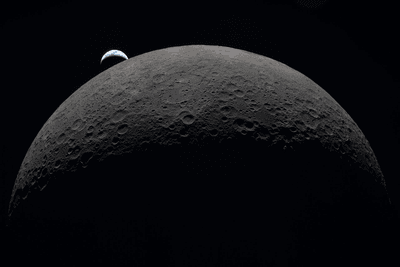


When President Trump asked the Artemis II crew whether they had seen a “Big difference between the far side and the near side…a difference in look, a difference in feel”, crew-member Jeremey Hansen responded; “The gravitational pull of the Earth has had a profound effect on the near side of the Moon, changing all those dark mares, those dark patches you see on the Moon from Earth. It's very different on the far side. While you see some small patches of those mare and deep craters, it’s very much absent on that side, so that’s really neat."
Hansen didn’t explain, however, how the Earth’s gravitational pull had produced such a difference. That could be because it’s still something scientists aren’t certain about. Indeed, the bit Hansen said puts him on one side of a live debate.
History Of The Lunar Dichotomy
It’s not hard to see the Moon has dark patches. Even a small telescope like the one Galileo first turned to the skies reveals these as distinct regions that are flatter and less heavily cratered than the rest of the surface. Several 17th-century astronomers independently called them “seas” (mare in Latin), but even then, it was known these were unlikely to involve water.
Missions that orbited the Moon, or looped behind it as Artemis II has done, revealed something unexpected, however: there are almost none of these seas on the far (not dark) side. More precisely, more than 30 percent of what we can see is sea, but only 1 percent of the other hemisphere. To explain this dichotomy, we first needed to know what caused the lunar seas in the first place.
The first two Apollo landings both took place on seas because the relatively smooth surface made for greater safety. Consequently, the first lunar rocks were able to confirm that the seas are primarily composed of basalt resembling provinces on Earth produced by volcanic eruptions. Later missions explored the highlands, either by landing there or travelling from the edge of a sea, and found the rocks to be mostly mafic plutonic rocks, ie those where magma solidified deep in the crust.
The Apollo missions landed at six sites across the near side of the Moon, and in some cases roamed quite widely to collect samples. That diversity was extended by the small samples from Russia’s three uncrewed missions. In contrast, the scientific community has only Chang’e 6’s 1.9 kg (4.3 pounds) to represent the far side, and analysis on that is still new. Consequently, our knowledge of its composition is largely restricted to what orbiters can detect from magnetism, spectroscopy and gravitational measurements.
Hansen’s Answer
Recently, the NASA Gravity Recovery and Interior Laboratory produced evidence that the differences between the two sides extend far beneath the surface. “Our study shows that the Moon’s interior is not uniform: the side facing Earth (the nearside) is warmer and more geologically active deep down than the far side. This difference is linked to the Moon’s volcanic history and explains why the two sides look so different,” lead author, JPL’s Dr Ryan Park, told IFLScience last year.
Park and colleagues concluded the nearside mantle is 2-3 percent softer than on the far side, requiring either drastically different composition, or being 100 to 200°C (180-360°F) warmer.
You certainly don’t get that sort of difference from exposure to Earthshine at the surface. The greater tidal forces Jupiter applies to some of its inner moons’ near sides might generate significant extra heat, but Earth’s gravitational pull is probably too small for a large direct effect. Instead, Park and colleagues note that there is more thorium and titanium in the near side’s crust. If this reflects an imbalance at depth, the thorium’s radioactivity, might account for the difference.
Even before this work, some models of lunar development proposed that 3-4 billion years ago the Moon’s mantle was partially molten. The stronger gravitational field on the near side would have caused some elements, including thorium, to migrate towards Earth, the models indicated, creating the difference in temperature.
If that’s right, the extra heat would have sustained volcanic activity much longer on the near side, allowing volcanoes to produce the seas after the early bombardment of the inner Solar System had died down. With fewer asteroids to smash up the surface, these later basalt planes could survive intact to become the “seas” of today, after earlier activity on the far side had largely been scrubbed clean.
Park’s team even think it is possible magma may be produced today 800-1,250 km beneath the near side – potentially explaining evidence of young volcanic beads, and a contributor to the gravitational differences they detected.
Although the evidence Park’s team has produced is impressive, less than a year after it was published is probably too soon to say whether it will prove to be the final answer. It’s possible the Earth’s gravity influenced internal lunar dynamics in other ways. Alternatively, the reason for the difference might lie somewhere else entirely.
Alternative Answers
Central to Hansen’s response is that the near side looks different because it is the near side – that facing Earth changed it. However, not everyone accepts that.
An early explanation that was offered for the difference proposed that for much of its existence the Moon was rotated by 90 degrees compared to its current orientation. N that case, what is now the far side was once the leading hemisphere as the Moon made its orbit. This, the argument went, meant it collided with asteroids head on, rather than being caught from behind, producing greater relative velocities, and therefore bigger impacts. This would explain why the far side is more heavily cratered. Eventually, however, it was admitted this explanation created more problems than it solved.
Nevertheless, the idea that the differences between the sides is more about history than relationship to Earth has not died. Other proposals include the Moon being the product of a merger between two original moons, or having been hit by a dwarf planet. In either case, such a cataclysmic event could have produced a body that looks quite different on one side from the other. It might just be chance that we got the side with the seas.
An analysis of rocks collected by Chang’e 6 published this year endorses this view. It attributes the differences between the two sides to the impact that formed one of the largest craters in the Solar System, almost 2,500 km (1,600 miles) wide.
Known as the South-Pole Aitken Basin, the crater is the reason nations are racing to get to the lunar south pole, rather than the north. The presence of low-lying areas there means ice from subsequent cometary impacts may have never been exposed to sunlight, and may have survived, making establishing a base much easier. The name might suggest the basin is centred near the South Pole, and therefore should have affected each side evenly. Instead the pole is near one edge, while the Aitken crater on the far side marks the northern boundary.
Supporters of the South-Pole Aitken Basin explanation think that the impact heated the lunar interior and redistributed materials within the Moon. “The nearside-farside dichotomy, such as volcanism and crustal thickness, is likely related to the South Pole-Aitken (SPA) basin–forming impact,” the authors of that study wrote.
If Hansen had explained all that, however, we’re not sure the audience would have kept listening.