


 Space and Physics
 PUBLISHED


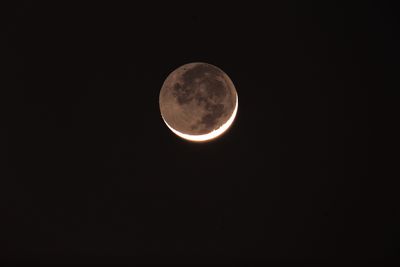


If you look into the sky in the late next week you may notice something about the Moon that’s been celebrated by poets and artists. Known as the "new Moon with the old Moon in its arms", it’s something you’ve probably seen many times before, but may not have really noticed.
In “Dejection: An Ode,” Samuel Taylor Coleridge introduces his poem with the lines:
Late, late yestreen I saw the new Moon,With the old Moon in her arms;And I fear, I fear, My Master dear!We shall have a deadly storm.
In the poem’s first stanza, Coleridge refers to the “New-Moon winterbright…I see the old Moon in her lap; foretelling the coming on of rain and squally blast.”
Coleridge was not the most scientifically accurate of poets (scientifically accurate poets are a pretty small club, although we can think of exceptions), so take his weather forecasting with a large grain of salt. However, the phenomenon he was referring to is real.
The new Moon with the old Moon in its arms is one of many names given to when a sliver of bright Moon can be seen, but the nightside is also faintly illuminated, rather than being completely dark. One might be able to see the mirror image this weekend, as the old Moon wanes towards renewal, but the best chance is around dawn.
The source of this light, also known as “the Moon’s ashen glow”, was once a puzzle, but Leonardo da Vinci, who liked to sketch it, was on the right track when he attributed the phenomenon to light reflected off the Earth’s oceans. Which is why it is also known as Da Vinci Glow.
It’s not just the oceans that light up the Moon’s night regions. During daylight, every bit of the Earth’s surface reflects light to some degree, and most of the time this is done diffusely rather than bouncing the light straight back towards the Sun like a mirror.
When the Moon is over the sunlit side of the Earth, it’s inevitable that some of that reflected light will reach it. The extra light has a barely noticeable effect on the Moon’s dayside, being vastly outshone by the Sun. However, where the Sun is still below the lunar horizon, Earth’s light is much brighter than the full Moon on Earth. As we have previously discussed, it’s enough to read by, albeit not comfortably.
Consequently, some of that light gets reflected again and returns to Earth for us to see. It’s quite a journey, if you think about it: Sun to Earth to Moon and back to Earth to reach your eye. Only a tiny proportion of the photons the Sun emits will make it, but fortunately, the Sun puts out a staggering number of photons.
This explanation has led to the more condensed, but still poetic, name Earthshine for when the night areas of the Moon are visible.
If the explanation is so simple, then why did Coleridge and others make such a fuss about seeing? If we saw this every time the Moon was a few days either side of new, how could anyone use it to predict (even inaccurately) bad weather?
The answer to those questions is that while the Earth’s dayside is always reflecting light, and therefore always lighting up the Moon to some extent, the amount of light varies a lot. Often the night side, or “old Moon”, is faint enough that we struggle to make it out.
When snow has blanketed much of the Northern Hemisphere, there’s much more light reflected than when the sunlight falls on forests or grasslands. One of the minor effects of global heating is that we’ll see Earthshine less often and less clearly.
Coleridge’s association between seeing the old Moon in the new Moon’s arms and storms isn’t entirely baseless – you see it more in the Northern Hemisphere winter. (The subpolar Southern Hemisphere is mostly water, so its reflection is much less seasonal.) To those living at high northern latitudes, the old Moon shone brightest during the stormiest months.
Clouds also reflect more light than sea or land. More clouds mean more Earthshine, but of course, the clouds can’t be where the observer is, or they’d hide the Moon. However, since what matters is the average cloud over half the planet, it’s not very helpful for predicting local weather conditions.
The maximum brightness for Earthshine has been calculated as magnitude -3.7. That’s much brighter than any star or planet except Venus at its peak. However, since the Earthshine is spread out and competing for our attention with the crescent Moon, it looks fainter. Moreover, the relative positions of Earth, the Sun, and the Moon mean that we only approach that maximum during daylight or shortly after sunset/before dawn.
Consequently, while the old moon is held in the new moon’s arms every month, conditions have to be right for us to see it, let alone notice when not specifically looking. However, the few days running up to and after a New moon are your best bet.

 1
1