Space and Physics
 PUBLISHED
 3
3


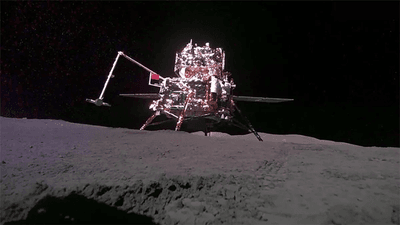


A new analysis of material brought back from the far side of the Moon by China's Chang'e-6 mission has found evidence that could help explain the unexpected differences between the two sides of the Moon.
The Moon is tidally locked to Earth, meaning that its rotation speed around its own axis matches the time it takes to orbit around the Earth. This is true of most planet-moon systems where the planet is much larger than the moon in question and close enough to it, as the smaller body's rotation speed is altered as it orbits the planet with much more mass until they are in sync.
Often referred to as the "dark side" of the Moon, the far side actually receives about the same amount of sunlight. But there are notable differences between the two sides, which we realized after the onset of space travel. Though heavily cratered, the far side of the Moon does not have the deep basins and "lunar seas" seen on the near side, and its crust was measured to be thicker by the Gravity Recovery and Interior Laboratory mission in 2012. It also, weirdly, appears to be more conductive.
There are a number of theories as to why the sides should be so different, including that there were originally two moons orbiting Earth, which collided early in the Earth's history; that a dwarf planet collided with a smaller Earth moon later on; or asymmetric crystallization of the lunar magma ocean, the layer of molten rock which covered the early Moon.
"Recent studies suggest that the lunar farside experienced a magma ocean evolution similar to that of the nearside," the team explains in their study. "Thus, the nearside-farside dichotomy, such as volcanism and crustal thickness, is likely related to the South Pole-Aitken (SPA) basin–forming impact."
Looking at rocks taken from the near and far side, the team found significant differences in the isotopes of potassium and iron trapped within them. Potassium evaporates fairly readily when heated, with lighter isotopes evaporating more easily. Looking at lunar material from the far side, the team found that it contained significantly heavier isotopes than material from the near side. The same was true of iron isotopes to a lesser extent, and the differences in iron isotopes they found could be explained with volcanic processes. But the same is not true of the differences in potassium isotopes.
The team suggests that these differences can be explained with an additional source of heating, likely an impact event that formed the SPA basin.
"This impact event could elevate mantle temperature to 2,800 K, which is sufficient for K [potassium] vaporization. For volatilization of a liquid into a vacuum, the vapor phase is enriched in the lighter isotopes, leaving the residual fraction progressively enriched in heavier isotopes," the team explains in their paper.
"This new result also implies that the SPA-forming impact was more energetic than other large basins, such as the Procellarum basin. Therefore, compared to the S [sulfur] isotopes, our high-precision K isotopic data provide robust evidence that the SPA impact heavily affected the lunar mantle, likely facilitating the formation of lunar dichotomy."
According to the idea, the impact likely melted the lunar interior, with heat-producing elements being unevenly distributed after the impact event.
"Our results thus provide robust evidence for significant impact-induced modification of the lunar mantle and demonstrate that large-scale impacts may have played a key role in creating lunar asymmetry," the researchers add.
While adding more evidence to the lunar impact hypothesis, we will have to wait for more samples from different parts of the Moon, and further analysis before drawing any further conclusions.
The study is published in the journal PNAS.