Nature
 PUBLISHED


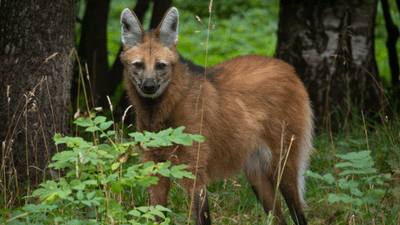


A day at the zoo brings to mind many smells. Suncream. Hay. Perhaps the odd heap of feces. You don’t expect such a place to smell like someone’s lit up a joint, however, and yet more zoos than you might realize come with the odorous smell of weed. Why? The maned wolf knows why.
The maned wolf, AKA the “skunk wolf” AKA Chrysocyon brachyurus, is an unusual character. It’s the largest canine in South America with limb proportions that bring to mind Slender Man. It looks like a cross between a deer, a wolf, and a fox, but it is in fact a genus all by itself.
They're the only member of the genus Chrysocyon (meaning “golden dog”), according to the Smithsonian's National Zoo and Conservation Biology Institute. With long black legs, flowing red fur, and large ears, these curious-looking critters get their name from a line of black fur that runs down their necks and backs.
Famously elusive, they’re shy animals that mostly live alone, but one area in which they aren’t afraid to make themselves known is their scent marking. Yes, the “skunk wolf” really lives up to its name when the time comes to urinate.
Living alone is all well and good until it’s time to make some babies. So, how do you hook up when you don’t actually want to spend time with your species? By pissing on a tree, of course.
Urine is a critical communicative tool for maned wolves. By marking out territories they can leave odorous messages telling other maned wolves to clear out or inviting them in for a gamete mixer. Living in such isolation may explain why their urine is so potent, needing to portray messages across large distances.
So, what might you smell while walking in maned wolf country? According to many accounts: weed. It seems the skunk wolf lives up to its name in more ways than one, producing urine that smells so convincingly of smoked cannabis that in 2006, police were reportedly called to Rotterdam Zoo in the Netherlands by a concerned citizen. They arrived on scene to find nothing but a load of animal pee, and science can tell us why the aroma is so distinctive.
A 2012 paper published in Chemical Signals In Vertebrates 12 investigated the composition of maned wolf urine, believed to be the trigger needed for a female to ovulate. It found a number of compounds that would quickly turn into a gas, producing a smell.
That included sulfur-containing hemiterpenoids – a kind of small organic molecule that’s produced by plants, insects, and animals. The smallest of the terpenes, hemiterpenoids are highly volatile, so evaporate easily and can be carried across vast distances. Add sulfur to the mix, and you can see why it has such a potent effect.
It’s thought these sulfur-containing hemiterpenoids are predominantly responsible for the distinctive smell of maned wolf pee. The resulting perfume is one described as being similar to certain skunk sprays, hops, tropical fruits, and – yes – cannabis varieties.
So, next time you think someone’s blazing up at the zoo, take a quick look around and see if there’s a maned wolf in the area. Chances are you’ve just been duped by South America’s largest – and arguably – strangest canine.

 1
1