Nature
 PUBLISHED
 7
7


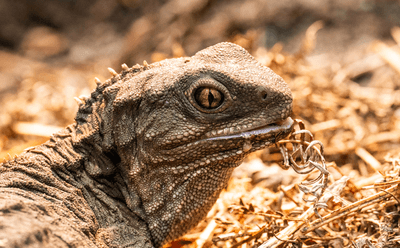


Chester Zoo recently announced the arrival of tuataras – a group of reptiles they describe as one of nature’s “greatest marvels” having lived on the planet for around 200 million years, since before dinosaurs existed – which have “three eyes”. It’s a lot of information to take in, but if that “third eye” fact is the one that has your eyes tripping, may we introduce you to the parietal eye?
Why do some animals have a “third eye”?
In nature, there exist some animals that you would describe as having two eyes, and yet in biology textbooks writers are referencing a “third eye”. This light-sensitive organ is found in many animals, including lots of lizards, as well as some frogs and fish.
It’s similar to a true eye in having a cornea, lens, and retina, but it can’t see like a true eye does. This is because the retina is a simplified take on the one you find in a true eye and so it’s thought they can only detect changes in light. There’s still much we don’t know about what, if any, function the parietal eye has, but some have hypothesized it could be a way for these animals to steer using the Sun, while others have suggested it could regulate the circadian rhythm.

What do you mean Chester Zoo has a 200-million-year-old reptile?
The tuatara (Sphenodon punctatus) is one of the world’s oldest surviving species, having lived on Earth before the dinosaurs and endured all the way to the modern era. Today, their native home is New Zealand, but Chester Zoo in the UK has become the first to ever successfully breed these reptiles in a foreign land.
“Tuataras are one of nature’s greatest marvels and provide an incredible window into our planet’s prehistoric past,” said Karen Lambert, Lead Keeper on the zoo’s Ectotherms department, in a statement. “Having somehow survived for around 200 million years, these unique animals are crucial to our understanding of reptilian evolution.”
“They're notoriously difficult to care for but, after nearly four decades, we finally perfected our efforts and have subsequently found success with a number of successful hatchlings following in 2017 and 2020. This really showcases the extraordinary lengths we will go to safeguard a species.”
You might ask why a species that’s survived since before the dinosaurs needs our help, but unfortunately tuataras are threatened in the wild due to invasive species arriving on the small islands they inhabit, and environmental changes driven by climate change. It’s hoped that Chester Zoo’s new resident tuataras can raise awareness about the challenges they’re facing in the wild, helping to secure the future of this remarkable “three-eyed” species.