


 Nature
 PUBLISHED


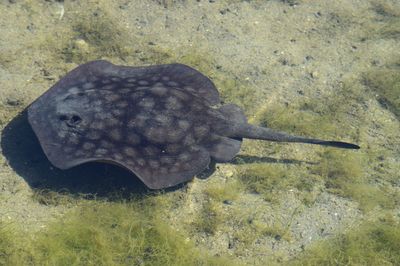


Remember a couple of months back when people thought a stingray named Charlotte was about to pop out a shark-ray hybrid? The aquarium responsible for her care has now posted an update on her pregnancy – and sadly it doesn’t feature little baby shingrays.
Sharing a video of Charlotte on social media, the Aquarium & Shark Lab by Team ECCO said: “Charlotte is continuing on her journey with Parthenogenesis! She continues to be healthy and has a great appetite! She also initiates interactions with the divers and guests.”
In other words, Charlotte is healthy, but still very much pregnant. Round stingrays such as Charlotte typically have a gestation period of around 3 months.
Interest in the pregnancy was piqued when some claimed that her offspring might be shark-ray hybrids, as there had never been male rays in the tank with her. Brenda Ramer, the founder and executive director of Team ECCO told ABC News 13 back in February that bite marks found on Charlotte could indicate that male sharks had mated with the female ray.
"In mid-July 2023, we moved two 1-year-old white spot bamboo males (sharks) into that tank. There was nothing we could find definitively about their maturation rate, so we did not think there would be an issue," said Ramer. "We started to notice bite marks on Charlotte, but saw other fish nipping at her, so we moved fish, but the biting continued."
Staff then suspected Charlotte might be pregnant later that year.
However, the shingray theory was swiftly debunked by animal experts. “They wouldn't be able to produce viable pups even if they could mate,” stingray expert Dr Joni Pini-Fitzsimmons, research fellow at Charles Darwin University, told BBC Discover Wildlife. “We can be sure that Charlotte's sharky tank mates aren't the fathers and she won't be pupping any shark-ray hybrids.”
The much more likely explanation for Charlotte’s pregnancy is parthenogenesis, stemming from the Greek words for “virgin birth”. You might have heard of this in the latest Jurassic World movie, where female velociraptor Blue managed to make a little raptor without a baby daddy – but while this is a fictional representation, parthenogenesis is a very real, albeit rare, phenomenon.
It’s a type of asexual reproduction, the ultimate example of sisters doing it for themselves; when there aren’t any males around, female stingrays can produce viable offspring without needing sperm. Though rarer in rays than other animals – a bamboo shark at the North Carolina aquarium had apparently reproduced this way 14 times – it has happened in captivity before.


 1
1