Space and Physics
 PUBLISHED


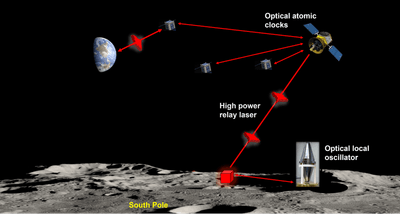


When humans return to the Moon, they will be faced with many challenges. The long-term residents of our natural satellite will have to be able to navigate an environment unlike any on Earth, without the infrastructure we use on our planet. One of those infrastructures is timekeeping, the foundation of modern navigation. Many solutions have been proposed to solve this problem, from shining lasers to building a lunar GPS. An intriguing new one suggests employing one of the unique features of the Moon: the craters of eternal darkness.
Due to the Moon's alignment and how it orbits the Sun with the Earth, there are deep craters at its poles whose bottoms are never reached by sunlight. These are the epicly named craters of eternal darkness. They are seen as an ideal location to place the most stable optical lasers ever made lasers inside a silicon cavity to produce groundbreaking timekeeping.
“As soon as I understood what the permanently shadowed regions can offer, I felt that this would be the most ideal environment for a super-stable laser,” lead author Professor Jun Ye from the National Institute of Standards and Technology (NIST) and JILA, said in a statement.
Those craters, and the Moon in general, are an ideal setting for those lasers because there is no air, very few vibrations, and the bottom of the craters is very cold, around -223.2°C (-369.7°F). The lasers operate at near absolute zero, but it is much easier to get there when you are already that cold. The cryogenic silicon cavity laser will work as a lunar-based master clock.
A second laser can be placed at the edge of the crater, acting as a relay between the ultrastable timekeeping laser and spacecraft going around the Moon or coming in for landing. It could rival the precision of optical atomic clocks, clocks so precise that they can measure gravitational changes as you move them about (and are now being tested at the top and bottom of a mountain).
“There will be very interesting discoveries that are waiting for us if we get to the times that are sensitive to the very small space-time curvature,” Professor Ye told IFLScience when it was announced he had won the 2022 Breakthrough Prize in Fundamental Physics.
There has been an increased interest in lunar timekeeping when it comes to future human exploration of the Moon, particularly the possibility of a permanent base, as proposed by NASA in its recent updated plans for the Artemis program – something we should hear more about in NASA's scheduled announcement next week.
NASA has already designated some of these permanently shadowed regions of the Moon near the South Pole as possible landing sites for Artemis. Ye's Breakthrough Prize-winning research has been fundamental in the invention and development of the most accurate clock in the world, the optical lattice clock, which just this year reached the best level of accuracy yet. He came up with the idea for the lasers on the Moon while discussing with colleagues the types of instruments the Artemis missions could take and install on the Moon.
“I thought, ‘let me throw out another crazy idea’ — except it turned out to be not so crazy after all,” Ye said.
From the laws of Einstein’s general relativity, we know clocks tick differently on the Moon compared to here. Clocks there tick 0.0000575 seconds faster per day than on Earth. That means that every 100,000 days (or about 274 years), someone on the Moon would have aged 5.75 seconds more than somebody on Earth. Sure, this is tiny for humans to experience, but for machines and navigation, that might be the difference between a safe or dangerous landing.
Until we have a Coordinated Lunar Time, scientists are working on syncing lunar time with Earth's, so the development of such a clock and the deployment of it for navigation could be revolutionary; benefits that might be reaped on Earth, too. It might improve navigation on and around our planet (something we also use supermassive black holes for) and for really high-precision timekeeping. Recent breakthroughs using optical atomic clocks have improved precision 100-fold, and we are getting closer to a redefinition of a second.
The study is published in Proceedings of the National Academy of Sciences.