Space and Physics
 PUBLISHED


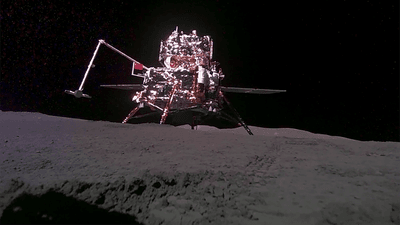


Chinese researchers say they have created a new "lunar time ephemeris" that can calculate the time on the Moon and sync it with time on Earth.
Currently, there is no agreed-upon time zone on the Moon. Uncrewed missions generally use the time corresponding to the craft's country of origin, while the crewed Apollo missions used Ground Elapsed Time (GET), counting from the moment of launch. As the Moon becomes a busier destination (with robots, and then, fingers crossed, humans), this could pose some problems that the US hopes to overcome by establishing a Coordinated Lunar Time (CLT) by 2026.
"With missions involving multiple landers, rovers, and orbiters, having a common time reference ensures that all units can coordinate effectively, avoiding conflicts and enhancing collaboration," a recent paper on the topic explains. "Accurate timing is crucial for communication between Earth and lunar missions, facilitating reliable data transmission and reception, and ensuring that autonomous systems can operate seamlessly."
The idea is not like adding a new time zone, nor is the problem as simple as having to translate a robot working on GMT to one working on PST. Though coordination of time is a goal, part of the problem is how fast time ticks on the Moon. As we know from Einstein's work, time is not fixed, but is tied to your velocity and the gravity of nearby objects. This is why time moves faster up a mountain.
"Due to general and special relativity, the length of a second defined on Earth will appear distorted to an observer under different gravitational conditions, or to an observer moving at a high relative velocity," Dr Arati Prabhakar, Assistant to the President for Science and Technology under Joe Biden, explained in a 2024 memorandum instructing NASA and other agencies to work together to create the new Moon time system.
"For example, to an observer on the Moon, an Earth-based clock will appear to lose on average 58.7 microseconds per Earth-day with additional periodic variations. This holds important implications for developing standards and capabilities for operating on or around the Moon."
While annoying to sync to Earth, this alone might not be enough to push humans toward creating a new time system for the Moon. However, just as special relativity has to be taken into account for GPS satellites around Earth, there are practical problems as humanity attempts to set up permanent bases on the Moon.
"Additionally, the navigation accuracy a system can achieve with signals from multiple space-based assets, such as a person navigating on Earth with signals from Global Positioning System satellites, depends on the synchronization of those assets with each other," Prabhakar continued. "At the Moon, synchronizing each lunar asset with an Earth-based time standard is difficult – due to relativistic effects, events that appear simultaneous at the Earth (e.g., the start of a broadcast signal) are not simultaneous to an observer at the Moon."
"Failing to account for the discrepancy between a transmitter clock on the Earth and how it is perceived by a receiver on the Moon will result in a ranging error. Precision applications such as spacecraft docking or landing will require greater accuracy than current methods allow."
Last year, a bill to establish Coordinated Lunar Time passed the committee stage with unanimous approval from the US House Science, Space and Technology committee. If written into law, it will require NASA to "develop celestial time standardization to support future operations and infrastructure on and around the Moon and other celestial bodies other than Earth, and for other purposes.”
While the US is attempting to come up with CLT, researchers from the Purple Mountain Observatory in Nanjing and the University of Science and Technology of China in Hefei have been working on a new software tool to quickly calculate lunar time and translate it to Earth time.
Dubbed the "lunar time ephemeris" or "LTE440", the system calculates the effects of time dilation, including the gravitational contributions from the Sun, all planets, the main belt asteroids, and the Kuiper belt objects".
According to the team, the system should "satisfy most current needs" of space-faring nations, and "has an accuracy better than 0.15 ns before 2050".
According to the Purple Mountain Observatory, the system is so accurate that errors would not exceed 1/20,000,000 second even after 1,000 years. The product has been released to the public, just in case you were planning your own Moon mission, and ahead of NASA's planned trip around our natural satellite in hopefully just a few weeks' time.
The paper is published in Astronomy & Physics.