Nature
 PUBLISHED


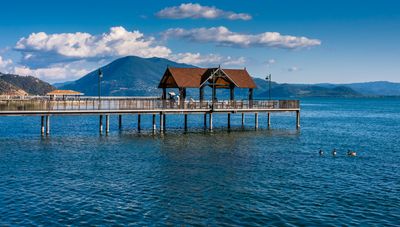


The Great Lakes of the Northeastern US and Canada may be the largest in the continent, and they’re almost certainly the most famous – but compared to some of their smaller cousins, they’re mere babies. Some lakes out there are 10 or more times the age of, say, the 10,000-year-old Lakes Michigan or Huron, defying the odds – and the very laws of geology – to hang on for literally millions of years.
The rest of this article is behind a paywall. Please sign in or subscribe to access the full content.Seriously. The oldest confirmed lake in the world is Lake Baikal, in Russia, and it’s around 30 million years old – meaning it predates, like, daisies and sunflowers. And that might not even be the true record holder: Lake Zaysan, in Kazakhstan, could be more than twice as old as that.
So, we’re just going to say it outright: no lake in North America comes close to either of these Asian ancients. But what is the oldest lake in the US?
Well… it’s complicated.
The old champion: Clear Lake, California
Located about 140 kilometers (87 miles) north of San Francisco, Clear Lake is the largest freshwater lake entirely within California. It’s home to countless fish – two-thirds of catches are of largemouth bass, but large populations of crappie, bluegill, carp, and catfish can also be found – and lush with wildlife: “There are year-round populations of ducks, pelicans, grebes, blue herons, egrets, osprey, and bald eagles,” boasts the website of Lake County, California. “The Basin also supports abundant populations of deer, bear, mountain lion, raccoon and other animals.”
Humans are no exception to the lure of Clear Lake. By the time Europeans reached the lake in the early 1800s, the region was already densely populated – and it’s no mystery as to why: not only flush with food, the lake is also sitting right on top of a volcano crater, meaning that the water is warm and the ground is rich with minerals. Today, it’s a hotspot for tourism, but there’s evidence of human occupation going back some 12,000 years – not all that long after humans first arrived in the area at all, geologically speaking. At that point, nobody was cavorting about the shores of, say, Crater Lake up in modern-day Oregon – it simply didn’t exist yet.
So, that’s pretty cool, but it’s far from the entire story. Clear Lake doesn’t just predate humans in America; it predates humans at all. “Through evidence from a series of cores to ca. 177 m maximum sediment depth, collected by the US Geological Survey in the 1970s and 1980s, Clear Lake is believed to be the oldest lake in North America,” confirms one 2003 report, “with continuous lake sediments of about 480,000 [years].”
It's unusual for a lake to survive that long, for a couple of good reasons. First, there’s the natural filling-in that happens to almost any untended body of water – with particles from the surrounding mud or rock; plants growing and dying in the water; with the bodies of fish and unfortunate animals that sink to the bottom over the millennia, and so on.
But when we’re talking about almost half a million years, there’s also the changing climate to take into account. “Clear Lake is unusual in having survived the advance and retreat of glaciers that scoured and obliterated most lakes outside the tropics, including the large lakes in California's Sierra Nevada,” pointed out researchers from the University of California, Berkeley, back in 2012.
Clear Lake has, in other words, been incredibly lucky. And what makes it even stranger is just how precarious its situation is: being tectonically active can (and has!) produce lava flows or landslides; it’s in an area naturally inclined to, you know, catch fire; there are near-constant droughts in the region; maybe most dangerous of all, humans just won’t leave it alone. It should, by any measure, have disappeared by now.
And yet, it has survived, outliving any other lake in the entire nation. Apart from one.
The new challenger: Lake Tahoe, Nevada/California
If you had asked for the oldest lake in the US before a couple years ago, Clear Lake would be the answer you got. But in September 2024, one geologist noticed something that everyone else seemed to have overlooked: that the (relatively) nearby Lake Tahoe was way, way older.
“I didn’t use any estimated ages in my ranking of lakes, only published data from research papers,” Winnie Kortemeier, the professor of geosciences at Western Nevada College who made the discovery, told SFGATE at the time. According to cores taken from Lake Tahoe in 2012 – by Kortemeier herself – it’s at least 2.3 million years old, making Tahoe much, much older than the official age of Clear Lake.
In fact, “it’s No. 3 in the whole world,” Kortemeier said, beaten only by Lake Tanganyika in East Africa and Russia’s Baikal.
What makes this discovery especially strange is just how obvious it was, at least in hindsight. “It’s just really hard to date a lake,” Kortemeier said, “but in Tahoe, it’s very clear.” That’s because the sediment core revealed that when lava flowed into the Tahoe basin 2.3 million years ago, it interacted with lake water and sediments – so “it’s very clear what the age of the lake is. It has to be older than 2.3 million years,” Kortemeier said.
Like Clear Lake, Tahoe is located in a geologically active basin – and that’s key to both lakes’ longevity. “The oldest lakes on the Earth are usually in an active fault basin, where the basin is still being actively faulted and formed,” Kortemeier explained. “So even if you put sediment in it all the time, the bottom is still being dropped down … and so the basins continue to deepen through time. And that’s why you get these ancient, ancient lakes, these really old lakes.”
“It’s really rare to have a lake form this way,” she said.
The complication
So, slam dunk you may think – Lake Tahoe has it. And officially, yes, that’s true. But there’s one hitch in the tale that should be borne in mind: how are we defining “age”? Or “lake”?
If those sound like odd questions, let us explain: Clear Lake may have a maximum age of 480,000 years, but that’s specifically the confirmed continuous age – the length of time you, or at least an immortal version of you, could theoretically swim around in the same body of water. But there’s been some kind of lake there for much longer: at least 2.5 to 3 million years, by some estimates. If all those lakes were connected, or if you’re just happy with a slightly looser definition of “lake”, then Clear Lake has a renewed claim for the top spot.
And remember: lakes are very difficult to date. There’s always a chance some other lake will be revealed as much older than we previously thought.
In fact, we’re already hearing rumors the Great Lakes are up to something – so watch this space, we guess.