Space and Physics
 PUBLISHED
 2
2




Humans have a habit of looking up at the wonders of the cosmos and noticing that they sort of look like stuff on Earth, if you squint enough or are blindfolded. For example, the constellation of Leo is said to depict a lion, when at best it resembles an incredibly low-res mouse.
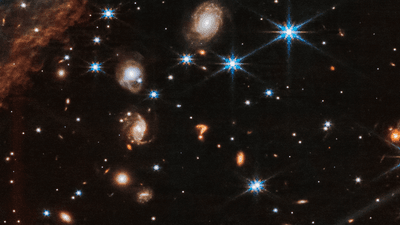
One thing we can all agree on, though, is that the JWST has spotted an object (or two, or three) out there that looks remarkably like a question mark.
When captured in 2023, the "cosmic question mark" was actually not the main focus point of the image (shown below); that was Herbig-Haro 46/47, a pair of stars that are actively forming, and can be seen in the center of the red diffraction spikes.
"Herbig-Haro 46/47 is an important object to study because it is relatively young – only a few thousand years old. Stars take millions of years to fully form," NASA explains. "Targets like this also give researchers insight into how stars gather mass over time, potentially allowing them to model how our own Sun, a low-mass star, formed."
When the image was released, however, the main thing that everyone (understandably) wanted to focus on was the punctuation lower down in the image.
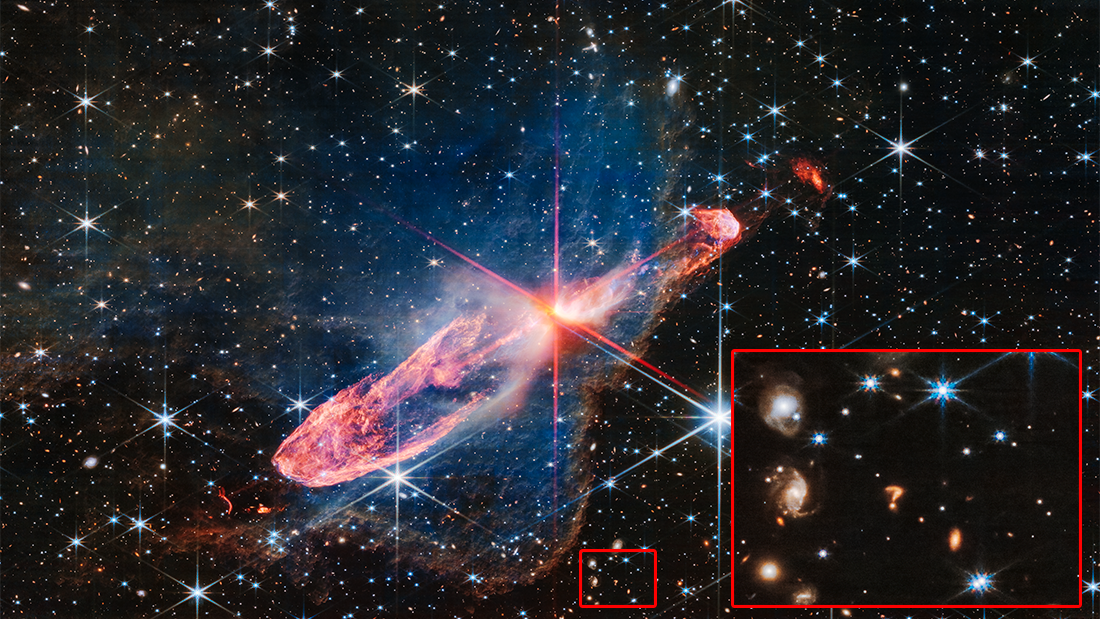
So, what is the big question mark in the sky? The image, taken by JWST's NIRCam (Near-Infrared Camera), which looks at the objects in infrared light, is made of several exposures. As you might be able to guess, the object is not a star.
"Blue objects with diffraction spikes are stars, and the closer they are, the larger they appear. White-and-pink spiral galaxies sometimes appear larger than these stars, but are significantly farther away. The tiniest red dots, Webb’s infrared specialty, are often the oldest, most distant galaxies," NASA explains.
What we are likely looking at is a distant galaxy, and one undergoing a merger.
“This looks like the kind of thing that you get fairly frequently — as galaxies grow and evolve over cosmic time — which is that they sometimes collide with their near neighbors," Matt Caplan, assistant professor of physics at Illinois State University, explained to CNN. “And when that happens, they can get distorted into all kinds of different shapes — including a question mark, apparently.”
While merging galaxies are of interest to scientists, they are fairly common, being the primary mechanism for galaxy growth in this age of the universe. This one, spotted in 2023, is not being rushed for more observations, despite the fact that from our angle, it sort of looks like a question mark.
However, astronomers have spotted another cosmic question mark in the interim.
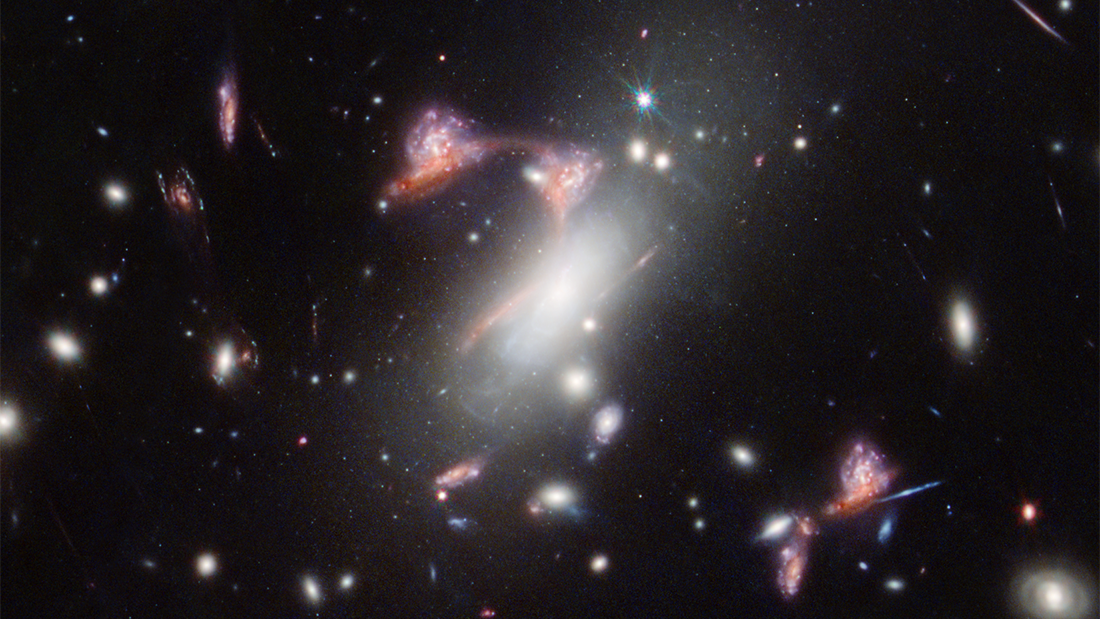
This cosmic question mark, seen in 2024, is courtesy of galaxy cluster MACS-J0417.5-1154, which is so massive that it is warping spacetime, causing gravitational lensing, magnifying objects behind it, and replicating them several times (from our vantage point).
"Two distant, interacting galaxies — a face-on spiral and a dusty red galaxy seen from the side — appear multiple times, tracing a familiar shape across the sky," NASA explains. "Active star formation, and the face-on galaxy’s remarkably intact spiral shape, indicate that these galaxies’ interaction is just beginning."
While not as impressive as the initial question mark, the gravitational lensing makes it more interesting, as far as space punctuation goes.