Nature
 PUBLISHED


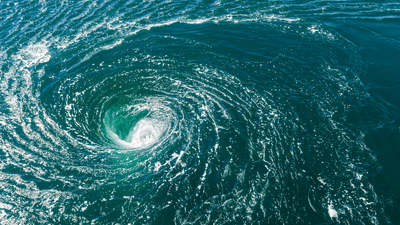


Whirlpools appear when fast-flowing water interacts with other currents or obstacles. Faced with a worthy opponent, the water begins to swirl in a downward spiral, creating a vortex capable of sucking in objects – or animals – that happen to be nearby.
Some whirlpools are small and brief while others can be enormous and driven by persistent currents. The most dangerous among them are called maelstroms. As for what happens when you get sucked into a whirlpool? First-hand accounts paint a grim picture.
What happens if you get sucked into a whirlpool?
The movement of the opposing currents can suck small objects, people, and sometimes even small boats into its mouth, where they can be pulled down into the water by the resulting spout. Once submerged, it can be very dangerous as the movement can leave people disorientated and stuck without air.
“When I realised I was trapped in a whirlpool, my first instinct was to try to swim out of it, but this proved hopeless,” Stuart Foulstone told The Guardian of his experience going into a whirlpool.
“I’ve since reviewed footage filmed by the GoPro camera attached to my helmet. The video shows I was underwater for almost three and a half minutes. I must have been dragged down almost to the riverbed, where the pull of the whirlpool lessened and released its hold. I was spotted face-down in the water and picked up by one of the kayakers.”
The depth a whirlpool can pull you down to depends on its size and power, and not everyone who has gone into one has lived to get out again. Bodies usually sink if someone drowns without a life vest as it's the air in our lungs that keeps us buoyant, but will later rise to the surface due to decomposition introducing more gases to the tissues.
How do whirlpools form?
Whirlpools and maelstroms can form in several ways, but most of the time it’s when opposing currents clash and spiral around one another, or one current meets an obstacle. Another way is the sudden formation of sinkholes created by collapsing caves. They cause water to flood the hollow structure, creating a whirlpool similar to the kind you get when you pull the plug out of a bath filled with water.
The various ways in which whirlpools can form means that sometimes they appear suddenly and without warning, while other areas are known for whirlpool formation because of the currents that pass through the area. The best way to stay safe is to keep out of the water, and flotation can make a real difference when it comes to getting out again.
That's why wearing your life jacket has and always will be super sexy.