Space and Physics
 PUBLISHED



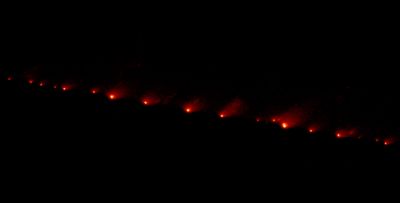


As the interstellar comet 3I/ATLAS exited the Solar System, it created one more burst of excitement by passing just outside Jupiter’s Hill radius. On the other hand, we sometimes hear about another boundary, the Roche limit, in similar contexts. So it seems like a good time to provide an explanation on the meaning of these two terms and how they relate.
The Solar System is a crowded place relative to most of the universe, with lots of objects large enough to exert a gravitational influence on their surroundings. But at a coarse scale, you often only need to worry about one object's gravitational field at a time.
This is because the strength of an object's gravitational field at a given point in space depends not only on its mass but also the distance between you and it. So even if you were positioned halfway between Earth and the Sun (hopefully with a very good heat shield), you’d have a hard time detecting Earth’s gravitational influence – the Sun’s would dominate due to its greater mass.
Thinking about it another way, it doesn’t matter to us on Earth's surface how many times greater the Sun’s mass is compared with Earth's; our proximity to the planet means we’re never going to fly off and be drawn into the Sun – not even if we jump. For those of us on the ground, high in the atmosphere or even in low Earth orbit, Earth’s gravitational field dominates.
The Hill radius, also known as the Hill sphere, is a way of defining the area within which a particular object’s gravitational field dominates. There are several alternative ways of calculating this concept, each of which gives somewhat different results, but the Hill radius is the most used one.
Within an object's Hill radius, moons or artificial satellites orbit stably and will continue doing so unless they experience a change in velocity that helps them escape. Outside the Hill radius, a second object may still be affected by the first's gravity and might even maintain a temporary orbit. However, the orbit won't be stable, and the satellite will eventually return to orbiting the Sun.
The Moon’s distance from Earth is a little over a quarter of the way out to our Hill radius, so there’s plenty of room for more moons if any want to join our little party. Quasi-moons like Earth’s Kamo’oalewa and Venus’s Zoozve, on the other hand, don’t orbit within their planet’s Hill radius, and therefore won’t remain in orbit.
The term “Hill sphere” can be somewhat misleading because the area is usually not perfectly spherical, being compressed in the direction of other massive objects. Other factors, like radiation pressure, can also influence the locations where an orbit is stable, but usually only at the margins.
The overall size of the sphere will also depend on the presence of other massive bodies. Neptune, for example, has less than 6 percent of Jupiter’s mass, but its Hill radius is more than twice as wide because it orbits further out, where the Sun’s gravitational field is weaker, allowing it to dominate a much larger area.
The Roche Limit
Massive objects in orbit around each other affect each other tidally. The stronger attraction on the near side of each object pulls them both a little out of shape. When the pair are comfortably far away from one another – like Earth and the Moon – this effect is small, only easily detectable because it pulls Earth's oceans back and forth.
However, as objects get closer, the tidal effects are stronger, pulling the smaller body more significantly out of shape. For an object only weakly bound together by gravity – a rubble-pile asteroid, for example – this will swiftly prove fatal. The area within which such an object starts to fall apart is known as its Roche limit.
Most of Saturn’s rings (and those of the other giant planets) lie inside the Roche limit of such loosely connected bodies, preventing the constituent particles coalescing into a moon. Indeed, one hypothesis for the formation of the rings is that they were the product of a moon that strayed inside the Roche limit and got pulled apart, although there are now alternative explanations.
Earth now has tens of thousands of satellites that orbit well within what would have been their Roche limit if they were held together only by gravity. These satellites can be as large as the International Space Station (and potentially much larger) because they are held together not by gravity but by skilled engineering, including welding and tightly screwed on bolts. This allows them to resist the tidal flexing that would stretch a looser object out perpendicular to the Earth.
Are They Connected?
One reason the Hill radius and Roche limit are sometimes confused is because there is also a concept called a Roche sphere, also named after the astronomer Édouard Roche. The Roche sphere is indeed very similar to the Hill sphere, and is seldom used any more, partly because things get so muddled.
Naming problems aside, both Roche limits and Hill radii grow with a planet’s gravitational field. However, for the Roche limit, the planet’s field is the main determining factor (though other factors like the radius of the satellite also come into play), whereas the Hill radius depends on the influence of neighboring bodies.
For a planet, the space between the Roche limit and the Hill radius represents the area in which a moon can stably exist, assuming it is held together by gravity.
Moons have Hill radii of their own. For most, these are exceptionally small, because as soon as you get far from the moon’s surface, the planet’s gravitational field dominates. For most moons, the Hill radius is smaller than the Roche limit, meaning there is no region in which natural satellites can exist.
However, the Solar System’s larger moons, particularly those further from their planet, have large enough Hill radii that they could theoretically support their own moons. This idea has been called moonmoons, and it is calculated that our own Moon, as well as Callisto, Titan and Iapetus, could have them.