Space and Physics
 PUBLISHED
 4
4



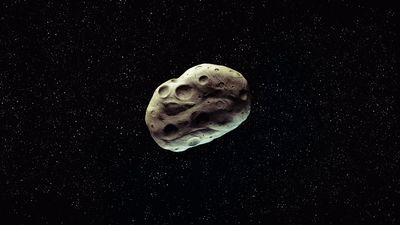


It is always nice to know we are not alone on our path, even if those companions are not exactly traveling with us. This is the fate of the quasi-moons of Earth, not-quite satellites of our planet whose orbit around the Sun also takes them around Earth. Now, Earth’s got a new one.
The object, known as 2023 FW, is small, not much bigger than a four- or five-story building. From the point of view of our planet, it goes around us at an average distance of 26.9 million kilometers (16.7 million miles), yet it is not a moon. The reason why this and the other quasi-moons experience such a weird orbit is because they are in a 1:1 resonance with Earth. That means they complete a full rotation around the Sun at the same time as our planet.
@AdrienCoffinet noticed it is a quasi-satellite of Earth. Astronomer, Sam Deen, located precovery images which help confirm the 1:1 resonance with Earth. This is the same type of orbit as Kamoʻoalewa (2016 HO3). https://t.co/c9EnXVooXY pic.twitter.com/BY2GEOPGzL— Tony Dunn (@tony873004)
But they are far beyond the region of the gravitational influence of the Earth, the so-called Hill Sphere, which extends up to 1.5 million kilometers (almost a million miles) away. The motion of quasi-moons around the Earth is happenstance and not our planet keeping them in orbit. Quasi-moons in fact come and go. The most stable known is 469219 Kamoʻoalewa discovered in 2016. This object might have been a piece of the Moon, has orbited Earth for at least a century and it will continue to do so for centuries to come.
A preliminary analysis of 2023 FW by French astronomer and journalist Adrien Coffinet suggests that the record of Kamoʻoalewa might be trashed by this newly discovered object. It might have been around since at least 100 BCE and will continue with us for a long while.
“It seems to be the longest quasi-satellite of Earth known to date,” Coffinet told Sky and Telescope.
Despite being a Near-Earth Object, 2023 FW is not any risk to us. It keeps its distance from our planet and if ever that were to change we would know with decades to spare.
[H/T: Sky and Telescope]