Space and Physics
 PUBLISHED




June is an excellent month for celestial events, and if you are in the mid-to-high latitudes of the Northern Hemisphere, things are even better as the nights are mild. So, get out there and look at the sky: no telescope necessary!
From asterisms to planetary conjunctions, June is truly a lovely month for space observation. And we might get lucky – there’s an unpredictable meteor shower waiting for us at the very end of it!
The core of the Milky Way and the Summer Triangle
Humans have always used the pattern of the stars to tell stories. This is how we got constellations. There are also other patterns that might be just as popular but with fewer mythological links: asterisms.
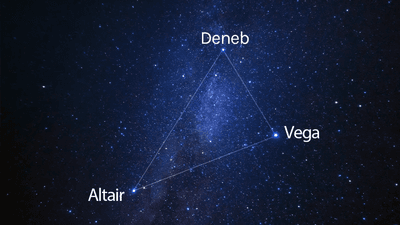
This month sees the emergence of one of the most famous ones: the Summer Triangle. This is made from three of the brightest stars in the sky: Altair from Aquila, Deneb from Cygnus, and Vega from Lyra. They are so bright, each the brightest in their respective constellation, that you need to try very hard not to spot it.
There’s also another reason why the Summer Triangle is exciting. Our galaxy, the Milky Way, appears to be going right through it. To see the Milky Way, you ought to find a nice place that is far away from light pollution. This might be an effort, but this is an excellent time to attempt it. In fact, it is the best time of the year to see the very core of our galaxy.
“This is the time of year when the Milky Way is visible as a faint band of hazy light arching across the sky all night,” explains NASA’s Jet Propulsion Laboratory (JPL). “You just need to be under dark skies, away from bright city lights, to see it. What you’re looking at is the bright central core of our home galaxy, seen edge-on, from our position within the galaxy’s disk.”
A cosmic kiss, while the twins are watching
If you can’t escape to a place with dark skies, do not worry. There is an upcoming spectacle that you can easily see from within a city. On June 8 and 9, Jupiter and Venus – the brightest planets in the night sky – will be less than two degrees apart. Look west after sunset, and they will be there, bright light, nothing else.
The conjunction, this cosmic kiss, will be pretty good. As the sky darkens during dusk, you will notice two other bright lights next to the pair. These are Castor and Pollux, the brightest stars in the constellation Gemini (the Twins).
If you do have a telescope, the conjunction is not the only thing you can see. At around 10:45 EDT, you will be able to catch the shadow of both Callisto and Europa – two of Jupiter’s Galilean moons – moving across the planet’s face.
The time of the night-shining clouds
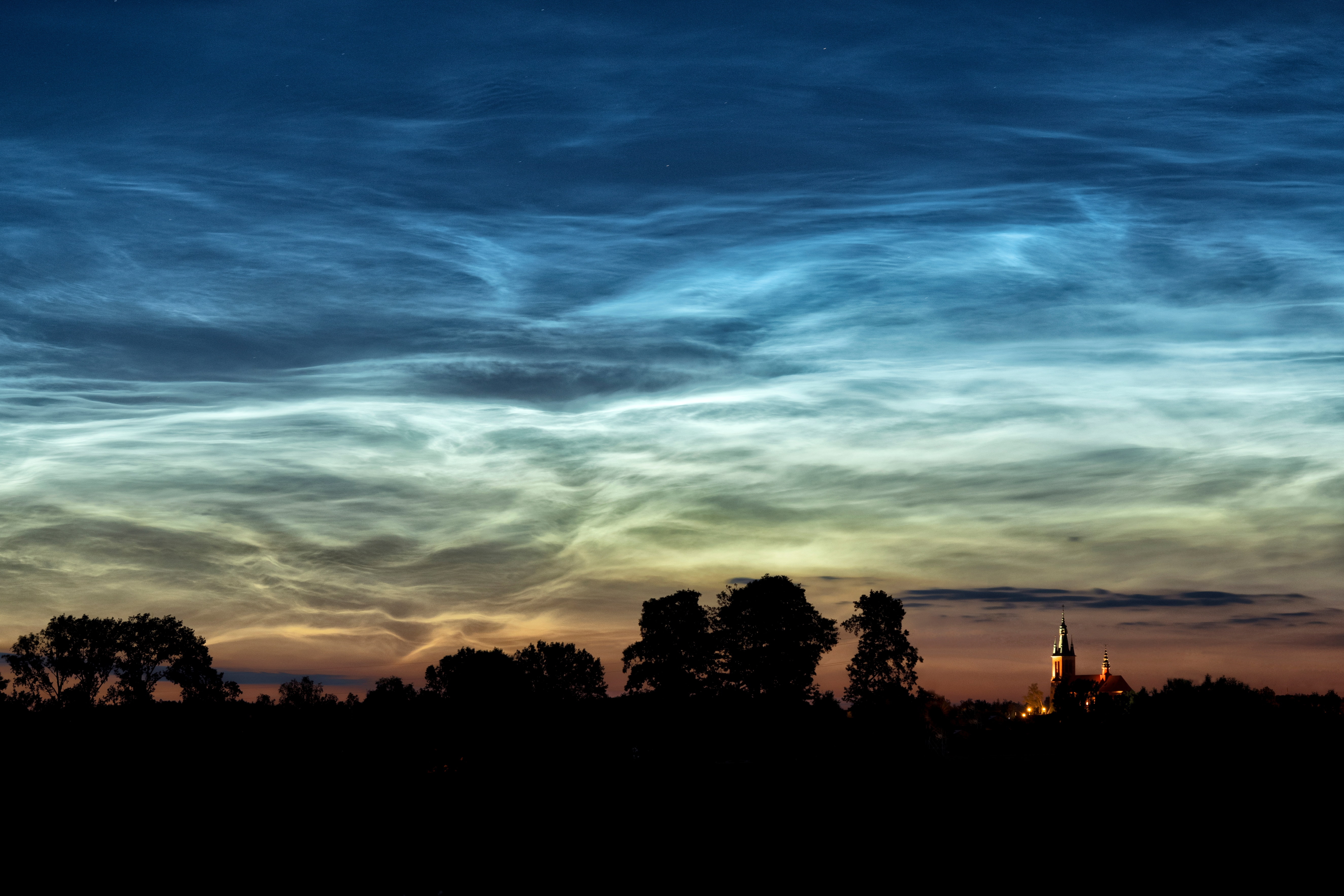
With apologies to our Southern Hemisphere brethren, this is the ideal time up north to see the noctilucent (or “night-shining”) clouds. They can appear any time between the end of May and the beginning of August, with June and July being the best time for them.
They are some of the highest clouds in the atmosphere, drifting around 80 kilometers (50 miles) high, and they are described as thin, wispy clouds. What makes them special is that they glow with a beautiful blue or silvery hue.
It is not a given that these clouds will appear, however. They tend to form at very high latitudes, although they can drift down to the United States and most of Europe. They are so thin that they can’t be seen during daytime, only during twilight hours when the Sun’s rays catch them just right.
For the people in the Southern Hemisphere, your best chance to see noctilucent clouds is during the austral summer from the end of November to early February.
A meteor shower that does what it wants
The month will end with a bang or with a whimper. We do not know for sure, because the June Boötid meteor shower is a surprisingly unpredictable beast.
If you had not heard of this shower until now, we are not surprised. Most of the time, the meteor shower is very weak, adding an extra 1 or 2 meteors every hour at its peak. It would almost not be worth mentioning it if it weren’t for the fact that it has unpredictable (as of yet) outbursts. When they happen, it is one of the most prolific showers.
Outbursts were recorded in 1916 and 1927 (and maybe 1921), which placed the shower on the map, but not significantly. For decades afterwards, recorded Boötids might have simply been other random meteors.
Then, in 1998, things got exciting again; on June 27, over 1,200 meteors fell across the sky over 12 hours. In 2004, it had another peak, with about 30 meteors an hour on June 23. Then things got quiet again.
Is 2026 going to be a good year? We will only find out between June 22 and July 2 – so wishing you all clear and dark skies!