Space and Physics
 PUBLISHED
 1
1





In the 1997 movie Contact, Dr Ellie Arroway, played by the excellent Jodie Foster, travels via a wormhole past Vega, showing a system with no planets but lots of debris. Hollywood might have gotten that completely right – it seems that Vega is not building any planets like other stars.
The star is one of the brightest in the Northern Hemisphere. It was for a time, and will be again, the North Star, once the pole has precessed away from Polaris. It is more than twice as massive as the Sun but it is a lot younger, around 500 million years old. It is so young, in fact, that it is still surrounded by a disk of material known as a protoplanetary disk. That’s where planets form. At least, usually.
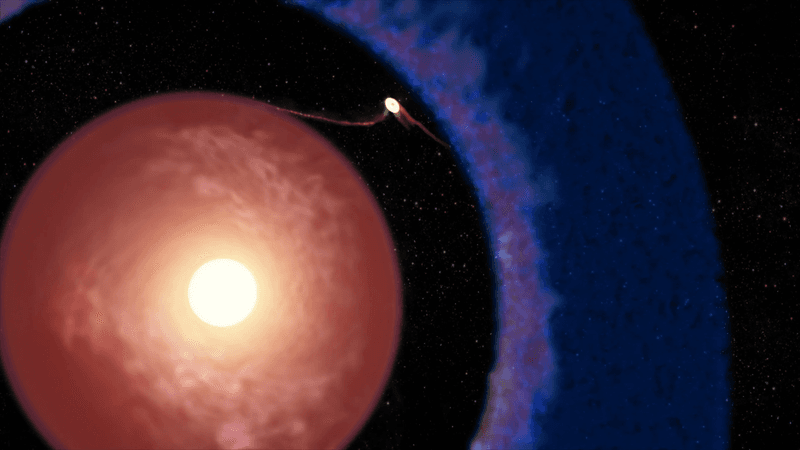
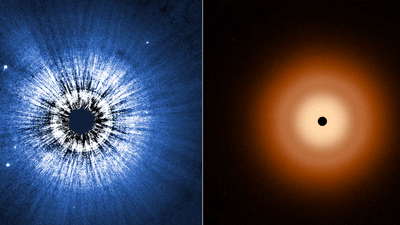
It seems that Vega is not a planet-producing machine. Other protoplanetary disks feature dark bands where planets are forming. The fledgling planets act like a snowplow, sweeping dust and gas in their orbit. The Vega disk stretches for 160 billion kilometers (100 million miles) and it is as smooth as you can get, bar a possible gap far from the star.
“It's a mysterious system because it's unlike other circumstellar disks we've looked at," Andras Gáspár of the University of Arizona, a member of the research team, said in a statement. "The Vega disk is smooth, ridiculously smooth."
"It's making us rethink the range and variety among exoplanet systems," added lead author Kate Su, also from the University of Arizona.
It took the combined power of Hubble and JWST to understand exactly how the material in this disk is distributed. The starlight from Vega has pushed away all the smoke-sized particles seen by Hubble further away, while JWST sees the dust grains as fine as sand, closer to the famous star.
"Different types of physics will locate different-sized particles at different locations," explained Schuyler Wolff of the University of Arizona team, lead author of the paper presenting the Hubble findings. "The fact that we're seeing dust particle sizes sorted out can help us understand the underlying dynamics in circumstellar disks."
There is a subtle signal at 60 astronomical units from the star – that’s about twice as far as Neptune is from the Sun. It is likely a gap, potentially indicating one singular baby planet. If it is the case, we are witnessing a peculiar system with no planets forming anywhere close to the star.
"We're seeing in detail how much variety there is among circumstellar disks, and how that variety is tied into the underlying planetary systems. We’re finding a lot out about the planetary systems – even when we can’t see what might be hidden planets," added Su. "There's still a lot of unknowns in the planet-formation process, and I think these new observations of Vega are going to help constrain models of planet formation."
The disk is particularly striking when compared to another star called Fomalhaut. It's at the same age, temperature, and distance (25 light-years) as Vega, but JWST has shown the hallmarks of planet-building around Fomalhaut. Why is Vega different? This remains a major open question that will require further studies.
Two papers describing the results will be published in The Astrophysical Journal, and are available here and here.