Space and Physics
 PUBLISHED
 12
12


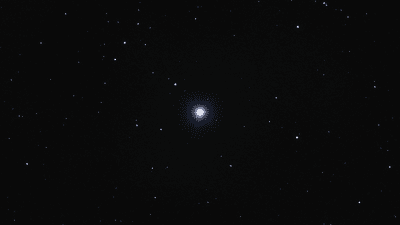


If you look up into the clear night sky in the Northern Hemisphere, you will see the star Polaris, more commonly known as the North Star.
Sitting around 1 degree away from the geographic North Pole, Polaris has been used in navigation (of the Northern hemisphere) for centuries. But it hasn't always been our North Star. That title has previously been held by binary star system Thuban, which was closer to the geographic North Pole between 3942 and 1793 BCE.
Thuban, named in Ancient Egypt and meaning “head of the serpent”, consists of a white giant star 2.8 times as massive as the Sun, with a secondary star thought to be an A-type main-sequence star around 2.6 solar masses.
The reason why it used to be, and one day will again be, our North Star has to do with the Earth's axial precession.
"Forces associated with the rotation of Earth cause the planet to be slightly oblate, displaying a bulge at the equator. The moon's gravity primarily, and to a lesser degree the Sun's gravity, act on Earth's oblateness to move the axis perpendicular to the plane of Earth's orbit," NASA explains. "However, due to gyroscopic action, Earth's poles do not 'right themselves' to a position perpendicular to the orbital plane. Instead, they precess at 90 degrees to the force applied. This precession causes the axis of Earth to describe a circle having a 23.4 degree radius relative to a fixed point in space over about 26,000 years, a slow wobble reminiscent of the axis of a spinning top swinging around before it falls over."
The effect is similar to that seen in a spinning top.
Currently, we are in a stage of this 26,000-year cycle where Polaris sits nicely in the direction of the North Pole. In 20346 CE, Thuban will reclaim its title as Earth's North Star.
In the Southern Hemisphere, where no particularly bright stars stand out, the Southern Cross is used by people looking for due south.