Space and Physics
 PUBLISHED


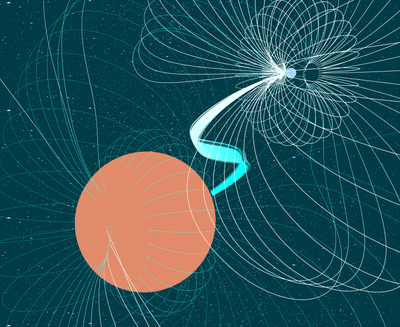


Astronomers have found clear evidence of the source of a Long Period Radio Transient (LPRT), a category that has proven a puzzle since their discovery. The radio signal is coming from a red and white dwarf locked in an orbit lasting just 1.3 hours, and producing regular X-ray bursts on the same period as the radio waves.
The development of radio telescopes capable of producing images of large areas of the sky has started a revolution in astronomy that is still in its infancy. Scans by telescopes such as the Murchison Widefield Array alerted the scientific world to classes of astronomical objects that were previously not only unknown, but not even suspected, including LPRTs.
When first discovered, LPRTs made no sense to astronomers: the signal looked like one from a pulsar, but slowed down far beyond what is considered theoretically possible. Yet enough examples were found quite quickly to indicate these oddities are reasonably abundant.
A potential breakthrough came in 2024 with the discovery of what appeared to be a red dwarf in orbit around a white dwarf at the source of an the LPRT, GLEAM-X J0704−37, followed by another, ILTJ1101+5521. Nevertheless, the finders of these systems remained uncertain as to how they were producing these distinctive radio signals.
However, University of Sydney PhD student Kovi Rose told IFLScience, although in both cases there was evidence to suspect a cataclysmic variable (CV) was the source, the proof was lacking. Rose is lead author of a study reporting the discovery of a new LPRT where the missing feature has been found.

CVs occur when a white dwarf and a main sequence star are locked in such a tight dance that the white dwarf can draw material from its companion’s outer layers. When this material settles on the white dwarf, it sometimes becomes so hot that fusion ignites. The burst of brightness makes a nova. Eventually, so much material might be captured that the white dwarf exceeds the critical mass of 1.4 times the Sun, triggering a Type Ia supernova.
Red dwarf stars have been identified at the sources of both GLEAM-X J0704−37 and ILTJ1101+5521, and in both cases the collected light has a stronger blue component than a red dwarf alone would produce. In each case, the finders attributed the bluish tinge to the presence of a white dwarf too faint and too close to its companion to be seen independently at this distance.
ASKAP J1745-5051 has similar features, with one important addition. Its light contains what Rose calls a spectral fingerprint of certain elements, which we see in CVs as those elements are captured by the white dwarf.
Rose and coauthors propose that the radio signal is triggered when the stars’ magnetic fields interact with electrically charged particles making the journey between the pair.
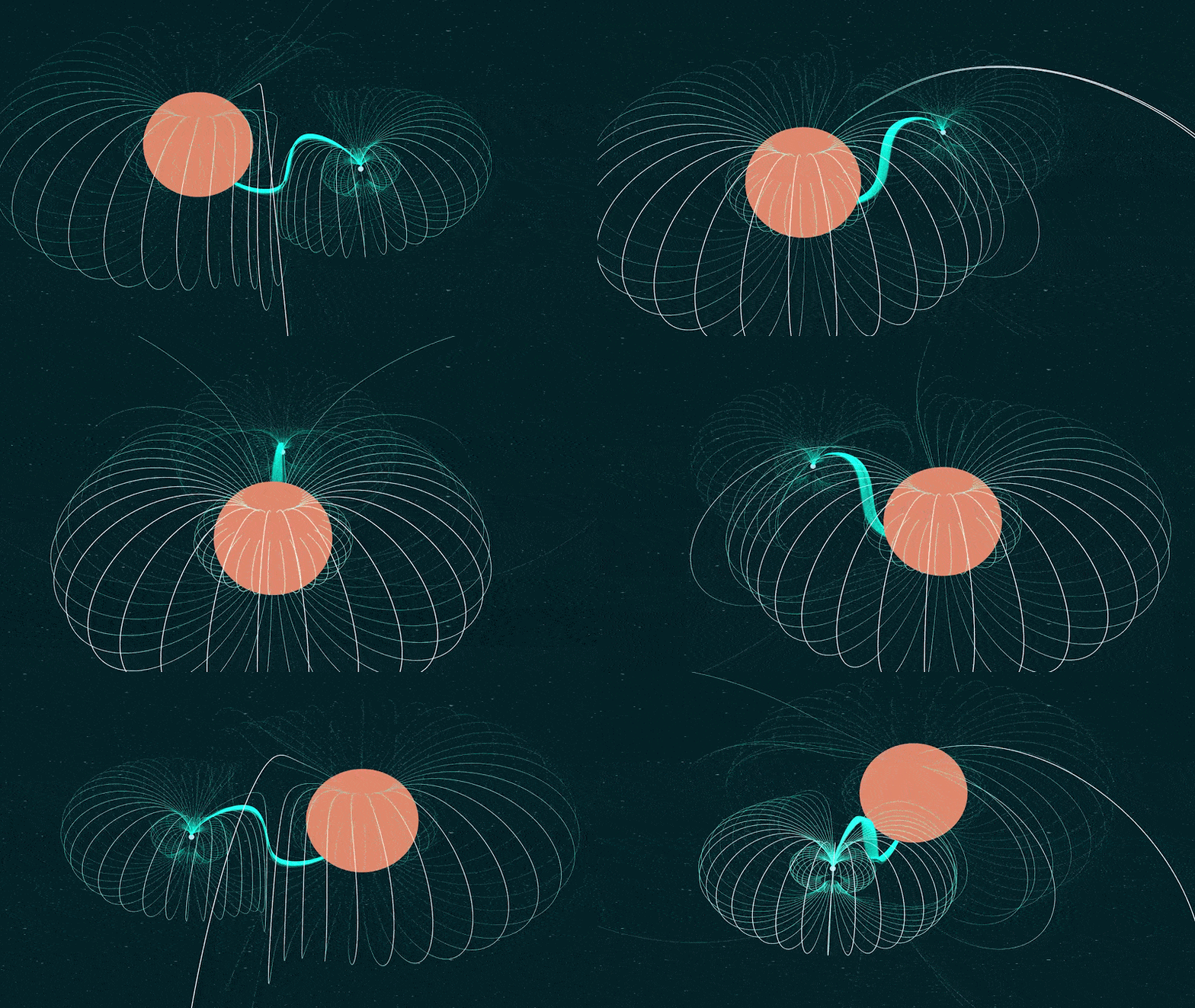
A further feature of ASKAP J1745-5051 is that it is also releasing X-rays, only the third time a LPRT has been found to do this. The X-rays cycle on the same 1.3 hour period as the radio waves. “These emissions are all tied to the orbital motion of the system,” Rose said in a statement. “But interestingly, the radio and X-ray signals don’t peak at the same time, which tells us they’re being produced in different regions of the system.”
The X-rays are thought to be produced when the material drawn off the red dwarf is heated to extreme temperatures, but whatever is driving these outbursts occurs at a different point of the orbit from the radio triggers.
We have found far more CVs than LPRTs, raising the question of why every CV is not an LPRT.
Rose told IFLScience in some cases this may be because the signal is pointed away from Earth, or we haven’t observed the stars through an entire orbit. He also noted that some CVs only accrete intermittently, and might not produce radio signals in between. Nevertheless, there may be unrecognized factors that cause only a few CVs to produce these signals.
Rather than sticking to a constant frequency, ASKAP J1745−5051’s signal drifts up and down the spectrum slightly, as well as having a complex structure of frequency peaks. Only one other LPRT is known to behave this way, but Rose and co-authors note we have seen something similar: the signals created by Io energizing particles in Jupiter’s powerful magnetic field.
The authors don’t think the similarity is a coincidence. “The intensity modulation the presence of local plasma acting as an interference screen to the beamed radio emission,” they write.
Having optical light, X-rays, and the full cycle of radio waves makes ASKAP J1745−5051 a “Rosetta stone” for other LPRTs where only some of these have been seen, Rose said. “We can use something so complete to fill in the gaps in terms of the whole population.”
There are reasons to think that there are two classes of LPRTs caused by different physical conditions. Rose hopes that ASKAP J1745−5051 will allow astronomers to distinguish those caused by CVs from those with quite different drivers.
The study is published in Nature Astronomy.