


 Nature
 PUBLISHED


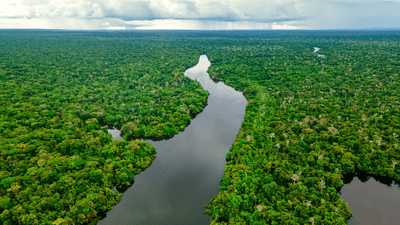


Imagine the Amazon. No doubt you’re thinking hot, humid, and a thousand shades of green, but really, the Amazon begins high in the frosty Andes. This is where melting snow and glaciers meet with rainfall and flow into the Amazon basin, feeding its dense network of rivers and tributaries.
It’s said the outflow of the Amazon into the Atlantic Ocean is equivalent to 219,000 cubic meters of water per second (7.7 million cubic feet per second), meaning it could fill roughly 7.6 million Olympic swimming pools in a day. It's the most voluminous river system on Earth, but one that’s matched by invisible flying rivers in the sky.
There are around 400 billion trees in the Amazon, trees that have evolved to make good use of the region’s dramatically differing dry and wet seasons. A single rainforest tree can pump 984 liters (260 gallons) of water a day, and its deep roots benefit surrounding shallow-rooted plants as they draw up water.
That water travels up the tree’s trunk and into its leaves, and as the tree transpires, it evaporates as vapor. This vapor condenses to form a concentrated flow of warm moisture that gets blown back across the Amazon basin like "flying rivers".
When it reaches the Andes mountains, it's like bouncing off a wall, and the streams of aerial water get redirected, spreading out to other parts of South America. This sends a huge amount of humid air to areas like Colombia, Ecuador, Peru, Brazil, Argentina, Paraguay, and Uruguay. When the flying rivers meet cooler air, they get denser, eventually releasing their water as heavy rainfall.
It’s estimated these flying rivers carry around 20 billion tons of water across the Amazon every day, which TED-ED says is more than the Amazon’s daily output into the Atlantic Ocean. It’s perhaps unsurprising, then, that flying rivers are crucial to life on Earth – but these powerful water systems are under threat.
It’s no secret that the Amazon is facing increasing pressures from deforestation, much of which is done to create space for cattle farming and extractive industries. Fewer trees means less transpiration and evaporation, drying up the flying rivers so that vast areas across South America experience reduced rainfall. This results in a drier environment, making more areas of land vulnerable to forest fires, drought, and hotter temperatures.
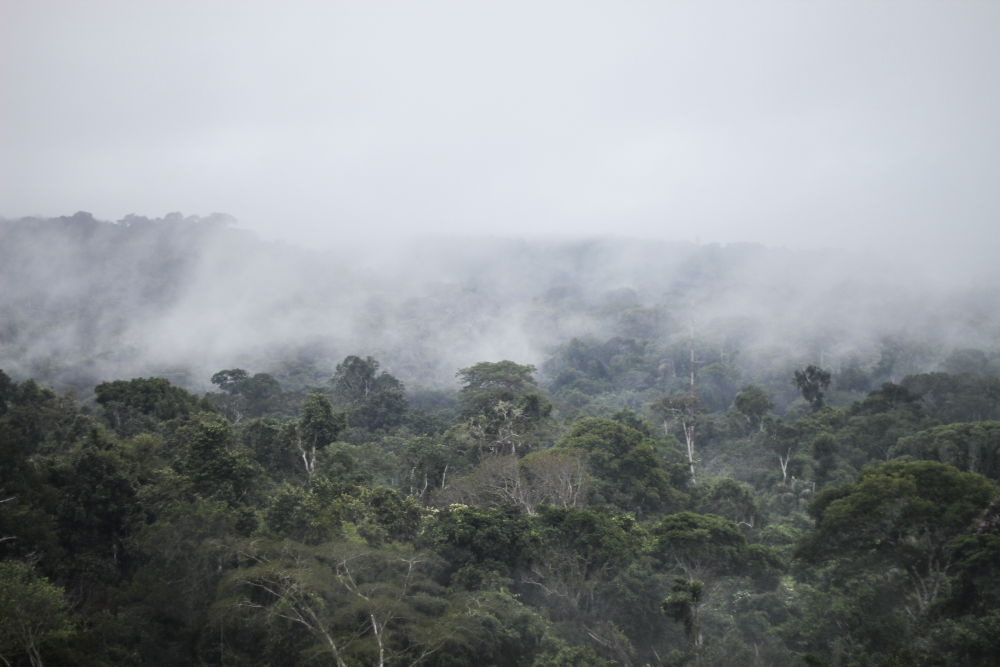
We can’t have flying rivers without the rainforest, and without the flying rivers, the rainforest can’t thrive. This is something the entire planet should feel passionately about, as if the Amazon were to dry up, it would release enormous amounts of stored carbon dioxide into the atmosphere, accelerating climate change and resulting in loss of biodiversity, economy, and human life.
Fortunately, the solution lies in the hands of those who know the land best. Indigenous Peoples like the Wampís Nation of Peru have lived sustainably with the land for millennia, and today, a community of 15,000 people is working as part of the Autonomous Territorial Government to protect over 1.3 million hectares (3.2 million acres) of land here.
Their approach prioritizes the conservation of animals, plants, and natural processes like flying rivers as a means of protecting the rainforest. Its success can be seen in the 34 million liters of water that transpires daily into flying rivers that keep Peru, Ecuador, and Colombia topped up with rainfall, and underpins the Wampís Nation's key philosophy: Tarimat Pujut, which means living in harmony with nature.
A lesson Henry Ford might wish he had learned before his disastrous attempt to create Fordlândia, an American ideal in the Amazon that was brought to its knees by caterpillars.


 1
1