Nature
 PUBLISHED


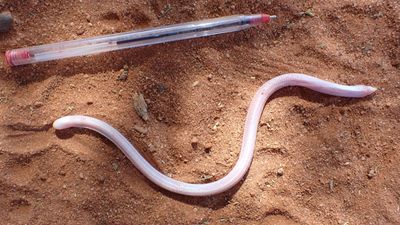


Being elusive might seem exclusively the realm of spies and space stuff, but animals are pretty good at it too, and one that takes the trait to heart is the Somali sharp-snouted worm lizard. Having not been officially seen in over 90 years, the odd-looking creature has now made a reappearance.
The Somali sharp-snouted worm lizard (Ancylocranium somalicum) was first reported back in 1931, when scientists discovered a subspecies of the reptile in what’s now the unrecognized state of Somaliland. It was here where it was rediscovered by Mark Spicer from the HALO Trust and his colleagues in January of this year.
“One day, one of our minefield supervisors, Hassan Du’ale, called me over to show me something interesting,” Spicer recalled to New Scientist. “I’m following him, we’re both wearing PPE [personal protective equipment] and he did a bit of scrambling around in the earth and produced a worm lizard.”
It turned out that worm lizard was the subspecies A. s. parkeri, after Mendel University herpetologist Tomáš Mazuch, who specializes in amphibians and reptiles originating from the Horn of Africa, confirmed it from photographs taken by Spicer.
The images give an insight into just how bizarre looking these flesh-pink creatures are – although we’ll refrain from being too scathing about their appearance lest they go back into hiding. At about 20 centimeters (7.9 inches) long, they’re roughly the same length as eight US quarters lined up (or the ballpoint pen used by Spicer) and feature a distinctive sharp pointed snout.

A. s. parkeri is a member of the amphisbaenians, a group of legless lizards more commonly referred to as worm lizards due to looking a bit like earthworms. Like their slimy doppelgangers, they’re often found underground and are adapted as such, with reduced eyes but beefed-up hearing.
Amphisbaenians have been found throughout tropical and subtropical regions in the Americas, Europe, the Middle East, and Africa, though this particular species has only ever been recorded in Somalia and Ethiopia. It’s a region that many first think of for its turbulent history, but the rediscovery of A. s. parkeri highlights the potential wealth of biological discoveries to be made there.
“It’s quite easy to look at this part of the world and think of conflict,” said Spicer. “There’s more to Somalia than that, including biodiversity.”
“Women and men in the minefields find all sorts of interesting stuff that never gets recorded,” Spicer added. “There’s probably scientifically interesting biodiversity seen on a regular basis; we just need more ways to capture them.”
The Somali sharp-snouted worm lizard isn’t the only elusive creature that’s made a comeback recently either – Attenborough’s long-beaked echidna came waddling back into view last year after 62 years out of sight.