Humans
 PUBLISHED





What you'll discover in this article
- The remains of a group of Ancient Egyptian princesses recently proved we can't rely on grave goods to make assumptions about sex.
- Professor Mary Lewis, an expert in bioarchaeology at the University of Reading, UK, has been exploring the clues – big and small – that can get us closer to identifying the biological sex of ancient remains, but the human life cycle means it isn't easy.
- Younger human remains can be incredibly difficult to assign sex with confidence. Of all the places, it seems our enamel could hold the answers.
A recent reanalysis of human remains from a pyramid complex in Egypt overturned the assumption that the presence of weaponry was enough to tell male corpses from female. The analysis detailed the mummies of several Ancient Egyptian princesses – thought to be sisters – who were interred with daggers and arrows.
These deadly items appear to have been far more than mere status symbols; the analysis suggests the women knew how to use their weapons. Signs left in their bones provide a biological record of “habitual, high-intensity mechanical loading,” study author Dr Zeinab Hashesh, Beni Suef University, Egypt, told IFLScience.
I called it the Holy Grail of bioarchaeology.
Professor Mary Lewis
"These princesses were not passive, decorative figures; they were well-conditioned athletes whose bodies were hardened by the same disciplined force as the men of their time.”
The reanalysis challenges assumptions in archaeology that have used weapons as an indicator of male sex. Meanwhile, females were associated with jewelry.
It begs the question: why rely on grave goods at all? If something like archery can be written in bone, then surely there are other, more direct indications of biological sex that we can glean from a corpse?
Male vs female
It turns out it's harder than you might think to identify sex in ancient human remains. Firstly, we don’t always have the entire body to work with. Then there’s the fact that the degree of human sexual dimorphism varies across our lifetime.
In other words, the remains of young men and women, and especially the remains of male and female children, look remarkably similar to one another.
When asked how difficult it is to identify sex in young human remains, Mary Lewis, a professor of Bioarchaeology at the University of Reading in the UK, said, “Very.”
“I think in my first book I called it the Holy Grail of bioarchaeology.”
We tended not to even bother to assign sex to children.
Professor Mary Lewis
That’s because when humans hit puberty in their teenage years, their bodies undergo a series of changes that can later make it easier to tell male from female. For males it’s primarily driven by an uptick in testosterone that encourages denser bones, muscles, enlarged reproductive organs, a deeper voice, and hair growth in new places.
Females experience a rise in estrogen, encouraging breast tissue growth, widening of the hips and pelvis, maturation of reproductive organs, changes in fat distribution, hair growth, and the start of the menstrual cycle.
Certain uncertainty
In a living, breathing human, these changes can be seen and heard, but it gets much trickier when all you have left is a skeleton. And it’s even harder when your skeleton didn’t live long enough to reach puberty.
“We tended not to even bother to assign sex to children,” said Lewis. “But since 2007, when I wrote my book, more work has come out where people have started looking at the pelvis.”
The adult female pelvis is wider than a male’s to facilitate pregnancy, but there are differences even in the fetal pelvises. However, if there’s one thing babies like to do, it’s grow, and the nature in which they grow means there’s a lot of overlap in terms of what looks male and what looks female.
According to Lewis, it means you can only say with about 50 percent certainty if a fetal skeleton was male or female. In other words, it's about as useful as guessing.
In an ideal world, you’d like to be nearer to 98 percent certainty – something we can hope to reach with the pelvis and skull of an adult – but in children, Lewis says, at best, you’re looking at closer to the 70 percent mark.
Micro-signs
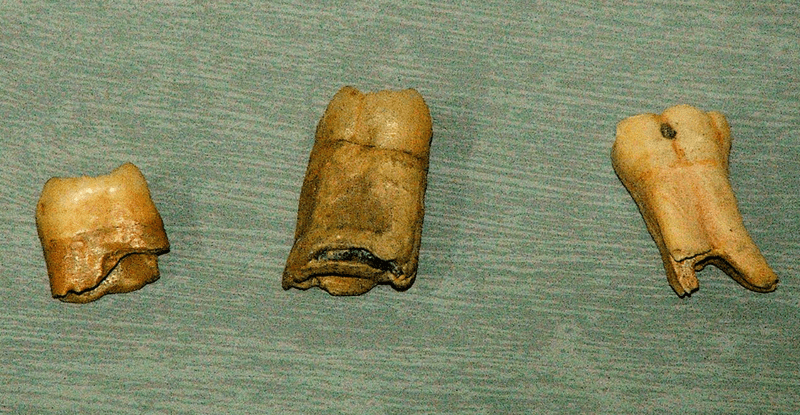
We can look to areas like the mandible and pelvis for indicative differences in the bones, but the more robust approaches for sex identification include DNA analysis or a newer alternative called peptide analysis. The latter generally involves taking a sample of enamel and looking at the amino acids it contains.
If you’ve popped a brow at the mention of enamel, I did too. However, as Lewis informed me, it’s a great place to look for samples because teeth preserve well (just look at the casts of Pompeii).
What we have shown time and time again is that urbanisation and industrialization has caused a massive delay.
Professor Mary Lewis
It works similarly to DNA, except rather than looking for X and Y chromosomes directly, you go in search of proteins produced by genes encoded on those X and Y chromosomes. Amelogenin is one example, being produced by the AMELX gene on the X chromosome and the AMELY gene on the Y chromosome, meaning it can be used to tell XY individuals apart from XX.
Enamel comes with the added benefit that it is less likely to be contaminated than the skeleton. That said, we know proteins can degrade over time, so there may be cases where there's no amelogenin to analyze.
Teeth themselves can display a degree of sexual dimorphism, as we see in other primates, which can be used to indicate sex. The only downside to that is that, in humans at least, we once again come up against overlap between the sexes that dilutes the degree of confidence.
Growing up different
We humans like to move to the beat of our own drum, and the same goes for our growth and development. It’s therefore difficult to identify concrete patterns in the skeletal development of young and adolescent humans that can confidently and consistently help us identify sex.
We are, however, getting closer, and as time, technology, and tenacious scientists march on, we’re even starting to identify the stage of puberty an ancient person reached before death. This was a puzzle Lewis was inspired to solve almost by accident when studying the remains of children who seemed too young to have developed ailments like arthritis.
I had people in mediaeval London – some of them were dying at 25 and they had not finished their puberty growth spurt.
Professor Mary Lewis
“There was a throwaway line in a really famous osteology anatomy book by [Louise Scheuer and Professor Sue Black] that the iliac crest, which is on the top of the pelvis, ossifies six months around menarche,” she said. “So, when a girl has a first period, the iliac crest will appear.”
“I was like, 'Oh, I didn't know that! I wonder if I got my research assistant to see if we could look for the iliac crest and would that tell us whether they were around puberty or not?'”
A deep dive into the literature revealed that the pelvis wasn’t the only part of the skeleton that exhibited puberty-related changes. Clinicians tracking the health of living teenagers also look to changes in neck vertebra, a wrist bone called the hamate, and fusion of the wrists and elbows.
A brief history of puberty
By combining and refining these skeletal signs, Lewis and colleagues have been able to establish a system for staging puberty in ancient remains that’s been tested in different populations over time. In doing so, they’ve revealed interesting patterns in how human lifestyles have altered physiology.
One of those lifestyle differences is urbanization. Compared with today, when people in urban environments often also have access to good nutrition, city dwellers in the past had it rough. Malnutrition was rife, illness spread, pollution was in the air, and conditions were more psychologically taxing compared with country life. A combination that took its toll.
“What we have shown time and time again is that urbanisation and industrialisation [in the past] caused a massive delay, particularly in [the first menstrual cycle] for girls, which are one of the easier ones to trace, and that boys and girls take much longer to get through the final stages of growth than they do today,” said Lewis.
“I had people in mediaeval London – some of them were dying at 25 and they had not finished their puberty growth spurt. They still had open fusion, (the) iliac crest might have still been open. And menarche was much more delayed – 15 to 17 as opposed to today, which is, what, 12.5? So, much later.”
Everything from pollution to psychological stress and starvation can influence the age and rate at which puberty occurs, demonstrating why being able to pinpoint this critical developmental window in human remains can tell us a lot about the world they were growing up in.
Identifying sex remains a complex part of the archaeological puzzle, but it’s fascinating to realize just how many clues are hiding across our bodies. Handy, when you realize you can’t lean on your outdated assumptions about who knows their way around a bow and arrow.