Humans
 PUBLISHED


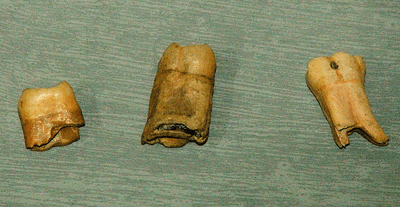


Around 30,000 years ago, a group of Palaeolithic Homo sapiens in France butchered and ate a Neanderthal child before turning their victim’s teeth into a necklace, possibly as a kind of trophy. At least, that’s what some researchers thought had happened.
A new analysis of the dental remains indicates that they actually belonged to a member of our own species.
Discovered in the Les Rois cave, the teeth date back to the Aurignacian period, when humans across Europe began creating symbolic artworks and making more complex tools.
Huge numbers of ancient artifacts – ranging from musical instruments to ivory figurines – have been found from this period, although weirdly, very few human fossils have been discovered in association with these relics.
As a result, scholars are uncertain whether the Aurignacian culture was exclusive to Homo sapiens or shared by Neanderthals. Les Rois may provide the key to solving this conundrum, as it contains the largest assemblage of Aurignacian human remains in western Europe.
Previously, all of the specimens at the site had been classified as modern humans, with the exception of the butchered teeth, which some researchers think might have belonged to a Neanderthal. Based on the nature of the cut-marks, it has been suggested that this unfortunate youngster was processed by Homo sapiens hunter-gatherers in the same way that they typically cut up deer carcasses.
This, in turn, was used to support a controversial theory that stated that Aurignacian humans killed and ate Neanderthals before wearing their teeth as jewelry. However, not all archaeologists accepted this hypothesis, and many questioned whether the teeth were Neanderthal at all.
Re-examining the ancient dentition, researchers have now confirmed that they actually belonged to a member of our species. For instance, they found that the incisors lack the characteristic “shovel shape” seen in Neanderthals, and instead display a “flat labial surface”, which is more typical of Homo sapiens.
The enamel is also much thicker than that seen in Neanderthal teeth, and falls within the range found in modern human teeth.
However, while the study authors assert that the dentition definitely isn’t of Neanderthal origin, they do note that it displays some Neanderthal-like features, suggesting that the dental morphology of Palaeolithic humans probably consisted of a mosaic of ancient and modern traits.
“With these new results, all human remains from Les Rois are now assigned to H. sapiens, supporting the broader attribution of the Aurignacian technocomplex (Early and Late) to this species,” they write. In other words, the complete lack of Neanderthals at Les Rois may suggest that the cultural innovations seen during the Aurignacian were entirely the work of modern humans.
What’s less clear, however, is how this prehistoric child was treated at the end of its short life. The cut marks, for instance, seem to indicate that the tongue was cut out at some point, although this doesn’t necessarily support the cannibalism theory.
Perforated teeth found at other Aurignacian sites suggest that humans may have developed unique funerary traditions during this period, and that turning the dental remains of the deceased into jewelry may have been a common practice. Moreover, the lack of human skeletons at these sites would seem to support the idea that people were doing something weird with the bodies of the dead.
Whether or not this explains the cut marks on the human teeth at Les Rois remains an open question.
The study is published in the American Journal of Biological Anthropology.