Humans
 PUBLISHED





What you'll discover in this article
- Prehistoric humans could have achieved their daily tasks with ape-like gestural communication.
- But telling stories around campfires enabled humans to create social identities.
- According to a new speculative paper by an anthropologist and a neuroscientist, this might have been the main driver for the development of language.
When humans mastered fire, they inadvertently created a unique social arena that enabled prehistoric hunter-gatherers to come together in the evenings and tell stories. This, in turn, provided new opportunities for ancient humans to create myths that helped forge cultural identities, all of which may have been the trigger for the emergence of language, according to a new speculative paper.
Previously, it had been suggested that language might have evolved in tandem with toolmaking, since the ability to teach certain complex techniques depended on advanced communication skills. However, the authors of a new review article point out that many nonverbal animals also produce tools, including apes, crows, and octopuses.
“It drives me crazy every time someone says language has to be about intention and meaning, because chimps have got that [in their gestures],” said review co-author Catherine Hobaiter from the University of St Andrews in Scotland. “But what other species are not doing is using communication to tell narratives, to create social identities,” she told IFLScience.
Noting that human infants make the same communicative gestures as many other ape species, the researchers argue that language has its roots in these communicative body movements. And given that other great apes are able to organize their societies, navigate conflict, and coordinate group hunting using these gestures, the authors suggest that language was never essential to the success of our prehistoric ancestors in their daily tasks.
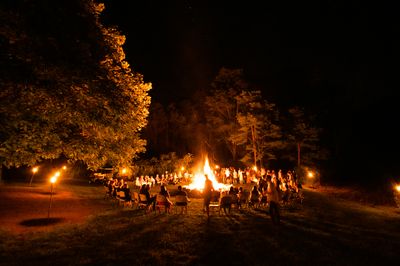
However, unlike other apes, humans spent their evenings sitting around campfires, and the authors argue this is where language flourished instead. “The ‘fireside niche’ brought something special to the mix, as it gave us this period of time at the end of the day when everyone was together and could really spend time connecting as a group,” said Hobaiter.
The researchers point to a highly influential study from 2014 that found language use among Indigenous hunter-gatherers in Namibia shifts dramatically after dark. During the day, the majority of conversations centered around mundane activities, yet once people gathered round the fire, storytelling became the dominant form of communication.
“Storytelling has those components of social identity, of narrative, of the things that make language uniquely human,” said Hobaiter. She therefore suggests that this form of communication evolved in the fireside niche in order to facilitate bonding and social synchrony.
And while this hypothesis remains totally unproven, the authors make six predictions that, if borne out, could be used to either confirm or deny their idea. For instance, they expect the rhythm, structure, and content of storytelling to differ significantly from everyday utilitarian speech, with creativity and abstraction being a defining characteristic of stories but not general conversation.
They also predict that the rhythm of storytelling should match the flicker rate of firelight, while the low-light conditions around a campfire will make gestures harder to see and therefore less effective as a form of communication. Finally, they suggest that storytelling may even cause the brain activity, heart rates, and behaviors of performers and listeners to sync up.
“These ideas are very testable right now with the kind of data we have,” said Hobaiter. Still, she and co-author Nathaniel Dominy at Dartmouth College in New Hampshire acknowledge in their paper that their review does risk "over-romanticizing firelight" if these tests aren't "constructed carefully and regarded sceptically."
Pending the outcome of these tests, the researchers speculatively write that “the use of language for storytelling so fundamentally reshaped the social worlds that it made us who we are today: Homo narrans, man the storyteller.”
The study has been published in the Proceedings of the Royal Society B: Biological Sciences.