Culture and Society
 PUBLISHED




Between the early Holocene and the Age of Empires, the number of languages spoken around the world skyrocketed from just a handful to tens of thousands. However, over the past few millennia, this cacophony of dialects has been largely silenced, with the expansion of political superpowers largely to blame.
To recreate the rise and fall of the spoken word, researchers mapped the linguistic diversity among 171 present-day hunter-gatherers, and used this to calculate the number of languages that existed 12,000 years ago, at the end of the last Ice Age.
Assuming a global population of under 7 million people, the study authors estimate that between 4,500 and 6,200 distinct languages were spoken at this point in our history.
The brief "golden age"
As the world’s population grew, so did the number of mother tongues, eventually peaking between 1,000 and 3,000 years ago when tens of thousands of languages were spoken. However, this “golden age” of linguistic diversity was short-lived, and was followed by a rapid and catastrophic collapse.
“The most unexpected result is how recent the peak appears to have been,” explained study author Claire Bowern in a statement. “The period of greatest linguistic diversity may have occurred not in the remote Palaeolithic, but during the era of expanding states and early empires”.
According to the researchers, the onset of the Age of Empires some 4,000 years ago didn’t immediately precipitate a decline in language proliferation. However, from about two millennia ago, the number of languages spoken worldwide appears to have fallen off a cliff.
The bottleneck
This process was largely driven by the expansion of multinational states and empires, which assimilated smaller communities and forced their own languages onto subjugated groups. As a consequence, the languages spoken by these superpowers became more widespread, while other regional dialects disappeared.
“The languages we see today are the survivors of a massive and highly selective historical bottleneck,” said study author Damian Blasi.
“A linguistic feature may be common not because it is inherently superior, but because it happened to be carried by populations that expanded. Extinction may have shaped linguistic diversity much more profoundly than we previously appreciated,” he added.
The decline
Today, we’re down to about 7,500 languages worldwide, which is more than the number that existed in the early Holocene, but an order of magnitude less than “golden age”. According to the Endangered Languages Project, about 3,300 of these are in serious decline, with 437 listed as critically endangered.
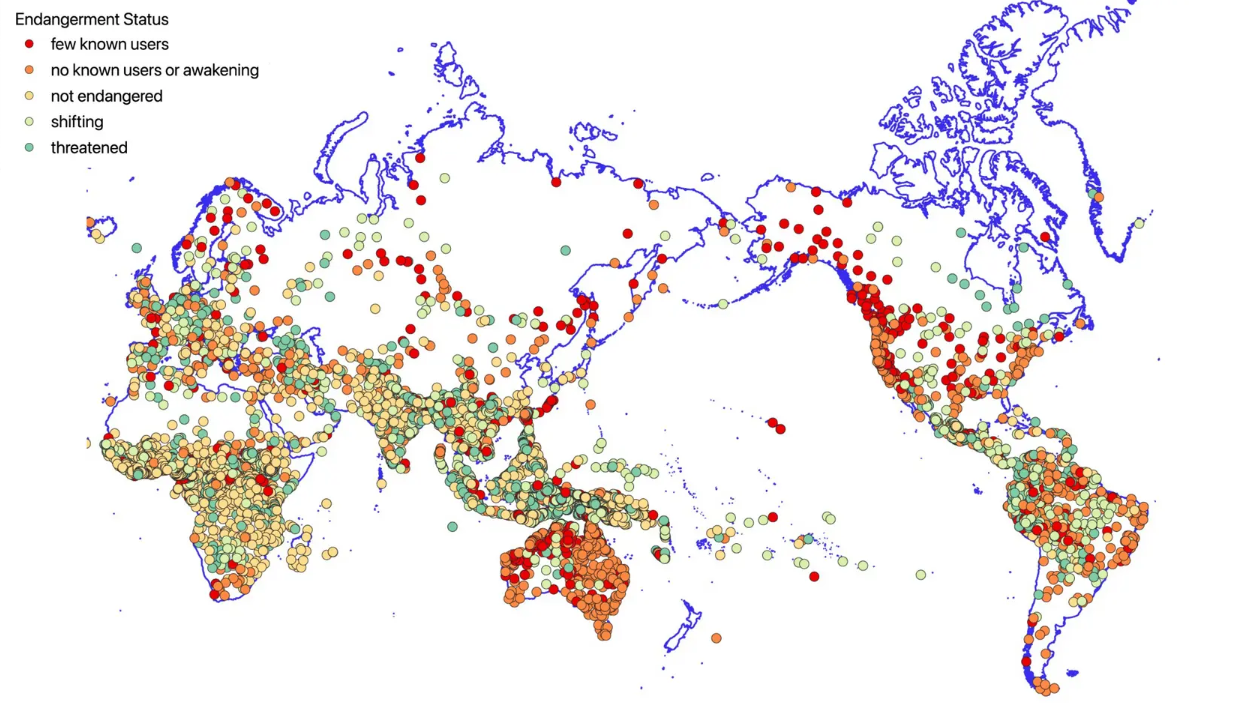
Over the past 50 years, more than 400 languages are thought to have become extinct, with colonialism one of the major causes. In the Kalahari, for instance, the imposition of borders through Indigenous homelands led to the fragmentation of N|uu-speaking communities, and the language now has just one remaining fluent speaker.
Legal prohibition and violence have played a major role in the extermination of many languages, while economic pressure to adopt dominant languages like English or Spanish has also contributed to a decline in linguistic diversity.
However, while the current rate of loss was once considered to be the most rapid in human history, the new study shows that thousands of years ago, languages were going extinct at an even faster pace than they are today.
The study is published in the journal Science.

 1
1