Humans
 PUBLISHED


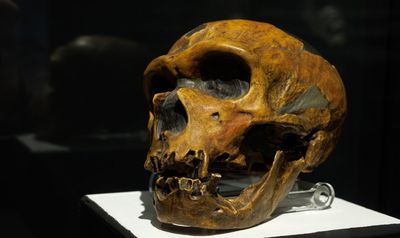


The capacity for complex language may not be unique to modern humans, as new research shows that the genetic regions underpinning this ability emerged before our species diverged from the Neanderthal and Denisovan lineages. Combined with the growing evidence for complex behaviors in these archaic hominins, these findings suggest that our extinct relatives may have possessed advanced linguistic capabilities.
The study authors assessed the language abilities of 350 elementary school children from Iowa, before sequencing the genome of each youngster. This allowed the researchers to hunt for correlations between genetic variants and language skills.
Results showed that the genetic mutations with the strongest impact on language were all found in so-called Human Ancestor Quickly Evolved Regions (HAQERs). These regions – which make up less than 0.1 percent of our genome – evolved rapidly after hominins split from chimpanzees, but before Homo sapiens branched off from an ancestral lineage that also gave rise to Neanderthals.
When you layer [the study findings] onto the archaeological evidence that Neanderthals had culture and organized social structures, it heavily implies that some form of complex communication was part of the picture.
Jacob Michaelson
Overall, the researchers found that mutations in HAQERs had 188 times more influence over the children’s language abilities than genetic variants in any other part of the genome. “What this tells us is that the hardware for complex language was in place earlier than we probably appreciated,” study author Dr Jacob Michaelson, a professor of psychiatry and neuroscience at the University of Iowa, told IFLScience.
“One of the most striking things we found is that Neanderthals had at least as many of these language-promoting genetic variants as modern humans do, and possibly even a little more,” explained Michaelson. While this doesn’t mean that Neanderthals were able to speak like us, it does suggest that their genetic toolkit was geared for language.
“We're not just saying 'Neanderthals had big brains, so they probably had language',” said Michaelson. “The same specific genomic signal that in 350 Iowa schoolchildren predicts how well they can take in, hold onto, and process language, is also present in Neanderthal genomes,” he explained.
“When you layer that onto the archaeological evidence that Neanderthals had culture and organized social structures, it heavily implies that some form of complex communication was part of the picture. I think our findings, along with what's been coming out of archaeology and ancient genomics more broadly, make the old 'did Neanderthals even speak?' question very hard to sustain.”
Curiously, however, the study authors found that the language-associated variants in the HAQERs have remained stable over roughly 20,000 years of evolution. This goes against expectations, as beneficial genetic variants like these are typically accumulated in higher concentrations over time due to natural selection.
The researchers believe this can be explained by the so-called “obstetric dilemma”, as HAQERs promote prenatal brain development, ultimately causing babies to have larger heads and resulting in major complications during childbirth.
“Prior to modern medicine, there was a hard ceiling on how big a baby's head could get before delivery became catastrophically dangerous for both mother and child,” said Michaelson. This means that the accumulation of HAQERs beyond a certain point may actually be detrimental to the survival of a species, despite the cognitive advantages that such enrichment might bring.
“Acquire more HAQER variants and your brain develops in ways well-suited for language acquisition; push too far and infant and maternal mortality climbs,” explained Michaelson. “The HAQER advantage hit that ceiling early and stabilized. So there's no free lunch.”
The study is published in the journal Science Advances.