Humans
 PUBLISHED




In the modern world, shows like CSI and CSI: Las Vegas would have you believe that if you commit a murder, you will leave behind some small trace of evidence at the crime scene, like a discarded Yeezy, which unreasonably attractive forensic scientists will find and use to secure your dramatic confession.
As a wannabe murderer, you (yes, you) may have daydreamed of traveling to the past to do your dirty deed when it could reasonably be assumed to have been much easier. Victorian England might do, or how about medieval China?
To that, we say: not so fast.
Though it was certainly easier to get away with the odd killing prior to modern law enforcement and forensics, that's not to say it was certain. There were people as far back as 13th-century China documenting the art of catching people for their crimes using more scientific approaches.
The first documented forensic entomologist
What is popularly called the first case of forensic entomology, in which insects and arthropods are used to solve a crime, comes from this period. It was documented in a book called Collected Cases of Injustice Rectified by Song Ci, who is arguably the world's first forensic scientist that we know of.
As part of reforms during the Song dynasty (960–1279 CE), each county was given its own official whose duties included investigating crime and then punishing those responsible.
"Where knife-wounds have been received while life was present, the skin and flesh will shrink"
Song Ci
Song Ci was initially trained in medicine, but in this newly introduced justice system was appointed the judge of prisons. He used this opportunity to collect knowledge of crime from around the country, and then recommended the best practices for investigating further cases.
Pre- or post-mortem wounds
Song provided practical advice to coroners examining bodies, including how to determine the cause of death. In one of many tips, he describes how to tell if somebody had been stabbed before or after death.
"Where knife-wounds have been received while life was present, the skin and flesh will shrink; there will be a subcutaneous stain all round. Wherever a limb has been cut off, the muscles, bone, skin, and flesh will be in a sticky mass; the skin shrunk from contact with the blade and the bone protruding," he wrote, according to a translation, of course.
"Where a corpse has been cut to pieces the skin and flesh will not change in appearance, there will be no subcutaneous stain, the skin will not have shrunk, there will be no blood at the end of the wound, and it will be of a white color."
"Attracted by the smell of blood"
Song also provided some horribly detailed knowledge of what happens to the human body under various scenarios, including attempting to figure out when someone died based on their decomposition.
But this wasn't only theoretical. He gave examples of real cases where these methods had been helpful. In one example, a coroner was able to solve a murder using a little investigation and some flies.
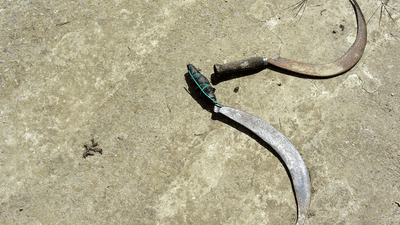
According to Song, a coroner had determined that wounds inflicted by a razor-sharp sickle had killed one villager. The coroner suspected murder, as the deceased man had, shortly before becoming a dead man, been arguing with another person about a loan.
The coroner traveled to the village where the suspect was believed to live, and asked every man in town to bring their sickles and lay them on the ground, an instruction which doesn't get issued nearly enough in modern times.
But despite all the sickles looking pretty clean, the culprit was dramatically revealed in a scene that could have come straight from an Agatha Christie novel.
"In a little while [the investigator] turned to the suspected man and accused him of the murder," the translation of Song explains. "He denied his guilt with many protestations, but the coroner pointed to the flies which had singled out his sickle among seventy others, attracted by the smell of blood. The murderer confessed."
While the first case of forensic entomology is the most interesting aspect to modern eyes, the book's main purpose was to inform investigators of the best practices available for investigating crime.
On that front, it is pretty impressive, carefully explaining the process from the moment you find a body to the point where it's time to present your sickles.
We've come a long way since then, and it should be a must-read for anybody who wants to travel through time to investigate ancient murders, rather than simply commit them.