Humans
 PUBLISHED
 1
1






The ability to communicate symbolically is one of the hallmarks of our species, yet scientists still don’t know exactly when our capacity for language arose. According to new research, genes likely to have enabled this unique skill may have evolved in our last common ancestor with Neanderthals and Denisovans, which means these extinct lineages might have carried the same linguistic programming we have today.
Despite this, the study authors stop short of suggesting that other human species were able to articulate in the same way we can, as they may have lacked the vocal hardware required for speech. Additionally, their cognitive abilities may have been insufficient to develop the complex system of symbols and meanings that underpin language as we know it.
To identify the genes responsible for articulate language, the study authors began by examining around 1,000 regions of DNA that are known to be involved in neural development in primates. Of these, they identified fewer than 50 that show clear signs of having undergone natural selection in hominins, all of which may therefore be related to linguistic ability.
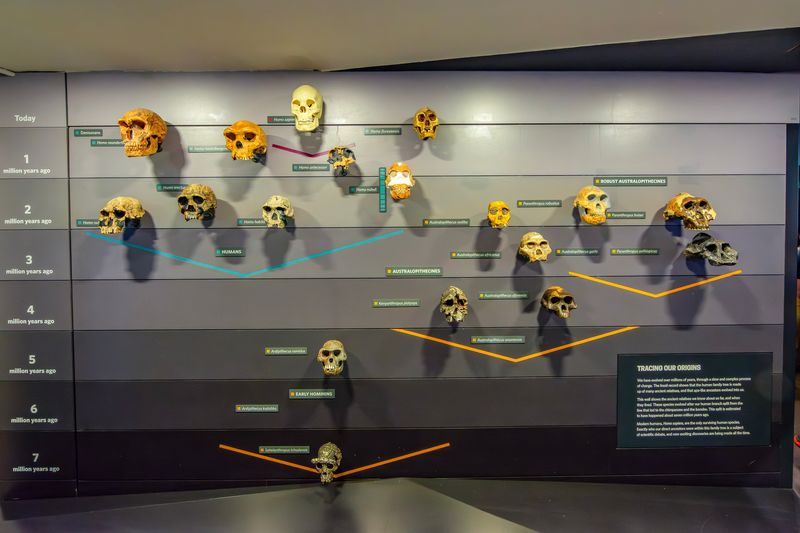
Surprisingly, the strongest burst of selective pressure on these genes occurs at the phylogenetic node where Homo sapiens, Neanderthal, and Denisovan lineages diverge, indicating that the most acute shaping of these genes took place in the last common ancestor of these three species. Even more bizarrely, signals of natural selection on these neural genes continue in the Neanderthal and Denisovan lineages, but not in our own.
“Homo sapiens is the only species of its genus that we know has language, and one might reasonably expect that it might show evidence of recent strong episodic and directional natural selection in this regard,” write the researchers. “That is not, however, what our analyses imply.”
Instead, their study suggests "that the genetic toolbox for the neural system that underpins language in modern humans was probably present in the ancestor of the Homo sapiens-Neanderthal-Denisovan triad.”
However, the study authors go on to explain that Homo sapiens are unique in possessing a descended larynx, which allows us to produce the vocal frequencies necessary for speech. Our brains also show enhanced connectivity compared with those of earlier hominins, suggesting that our capacity for “associative symbolic thought” may far exceed that of Neanderthals and Denisovans, ultimately rendering our species as the only one able to use sophisticated language.
Nonetheless, the results of this study show that the genetic framework from which language later emerged may already have been in place before we diverged from our ancient sister lineages. Moreover, the researchers were able to determine that the majority of genes in this linguistic “toolbox” were related to synapse structure and maintenance in the brain.
In other words, language emerged in humans thanks to the evolution of genes that enhanced the efficiency of our brain connections, all of which appear to have been possessed by Neanderthals and Denisovans. For example, genes like CACNA1C and GABRG2 control synapse formations, CUX1 plays a role in synaptogenesis, and CACNB4 regulates the activity of high-voltage-gated calcium channels, which are essential to synaptic plasticity and the capacity for complex learning.
Ultimately, none of these genes directly enable language, but collectively they appear to be necessary for the formation of linguistic abilities. As such, the researchers explain that these regions represent the genomic “substrate for the sophisticated vocal system on which Homo sapiens eventually built language, rather than the substrate of language itself”.
Exactly what this meant for Neanderthals and Denisovans is unclear, and it’s still impossible to say if they were capable of language as we know it. Or, as the study authors put it, “there are many mysteries to clear up about language before we can even begin to look for genomic silver bullets.”
An unedited version of the study has been published in Scientific Reports.