Humans
 PUBLISHED
 1
1





What you’ll discover in this article...
- The way we categorize extinct human ancestors doesn’t reflect our family tree, and paleoanthropologists increasingly agree it needs to change.
- Broadening the definition of the genus Homo to include all species more closely related to us than chimpanzees has been proposed as a solution.
- Talking to IFLScience, Dr Ian Towle said that updating the taxonomy of ancient humans is “a big issue, which is why people put it off year after year.”
For decades, paleoanthropologists have been learning that human evolution is much more complex than they used to think.
We have reached a critical mass of problems that can’t be ignored. With the new fossils and genetic advances, I think now is a good time to do it.
Dr Ian Towle
Now one scientist has proposed that the best way to reflect that taxonomically is to abolish the genera Australopithecus and Paranthropus, welcoming both into our own genus Homo.
With any other branch of the tree of life, this might be a question only of interest to specialists, but for our own genus it could subtly change the way we think about ourselves.
The binomial naming system for species dates back to Carl Linnaeus in the 18th century. All animals, plants, fungi, and even single-celled organisms have a genus and species name. While the system as a whole has proven remarkably robust, many of the names have been reconstructed - often several times - to better reflect who is most related to whom.
In particular, it is now widely accepted that a genus should reflect cladistics – grouping species with a common ancestor – rather than apparent similarity.
However, according to Dr Ian Towle of Monash University, we haven’t been similarly adaptive with our own genus.
The messy human family tree
The problem is most severe when it comes to Australopithecus, whose most famous member is Lucy.
“One or more Australopithecus taxa are recovered as more closely related to Homo and/or Paranthropus than to other Australopithecus taxa,” Towle writes. “Consequently, Australopithecus continues to function largely as a non-monophyletic “wastebasket” grade rather than a well-defined evolutionary clade.”
A wastebasket taxon is basically a group of species which scientists group together not necessarily because they are most closely related, but because they don't know where else they should go on the tree of life.
Similarly, the multiple hominin species in Paranthropus superficially resemble each other, sharing strong jaws and teeth. Yet many paleoanthropologists are coming to suspect that this is an example of convergent evolution, and that Paranthropus in different parts of Africa actually evolved from different Australopithecus species.
Our own genus, Homo, was once reserved for very large-brained members. This led to initial resistance in including other ancient humans such as our likely ancestor, Homo habilis. But more recently other hominins have been added, including Homo floresiensis and Homo naledi, despite having dramatically smaller brains.
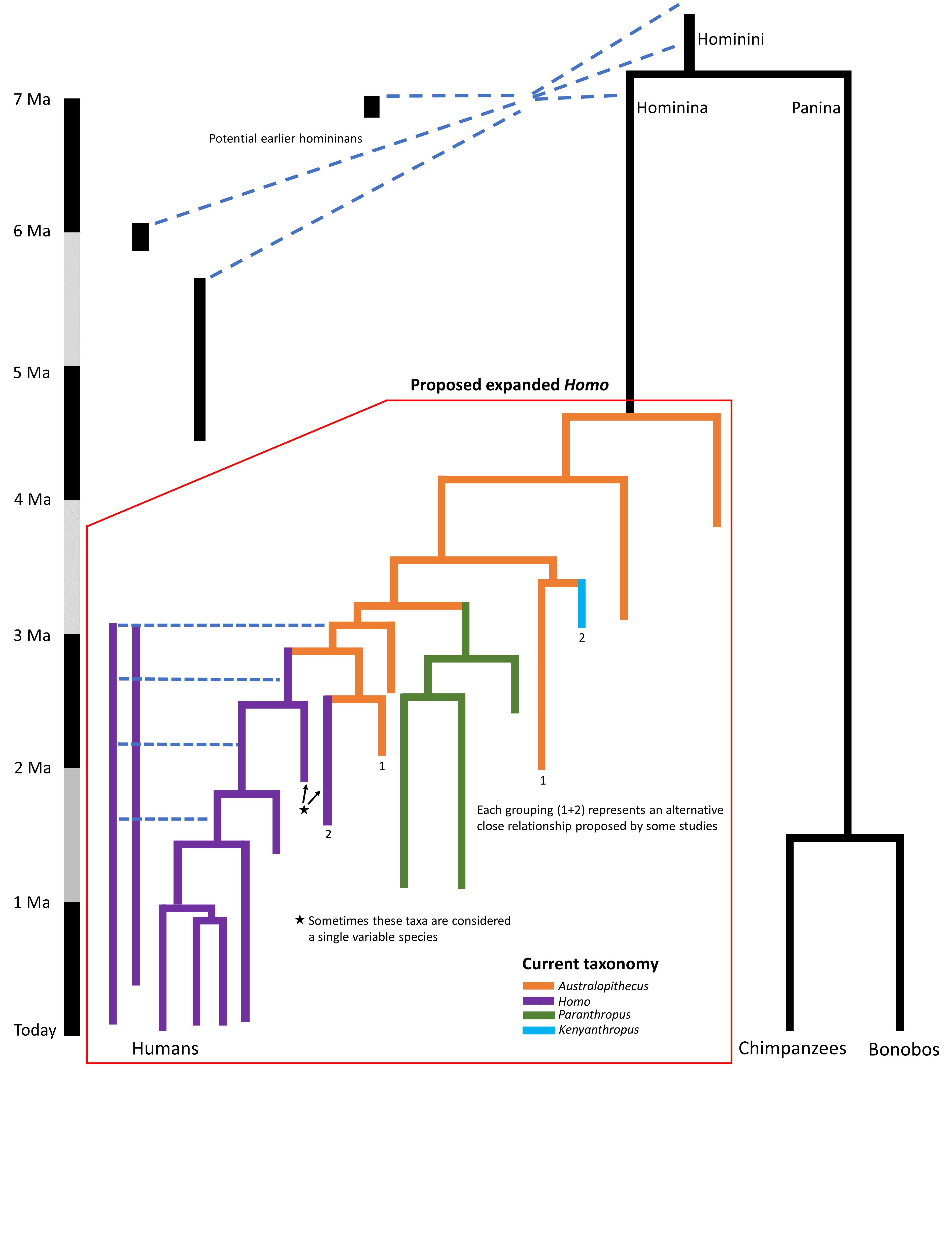
The best way to address this, Towle argues, is to include all species more closely related to us than to chimpanzees in one genus.
This would bring Australopithecus, Paranthropus, and Homo together, along with Kenyanthropus platyops, which is sometimes considered to be in Australopithecus. If this happened, all species would take the genus name Homo, with the new arrivals keeping the second part of their binomial naming.
That means, for example, Australopithecus afarensis would become Homo afarensis.
“The more we learn about our ancestors and close fossil relatives, the more we realize how complex and non-linear our family tree is,” Towle said in a statement.
Now is the time
Talking to IFLScience, Towle said that while there is widespread agreement that the current taxonomy doesn’t work and needs an overhaul, there little consensus on how to do it.
Any such change requires the rewriting of decades of textbooks and studies, and leaves people who learn the new taxonomy confused when they read old papers that use different names.
“That is a big issue, which is why people put it off year after year,” Towle said. However, he believes “we have reached a critical mass of problems that can’t be ignored. With the new fossils and genetic advances, I think now is a good time to do it.”
Some have proposed addressing the situation not by cutting the number of genera down to one, but instead by creating more, in particular by breaking up the Australopithecus genus.
Towle rejects this, arguing that some of the new genera created would include only one species, which he considers undesirable as the genus name would then provide no extra information.
Towle also told IFLScience that one of the driving forces for changing taxonomy has been the awareness that interbreeding between species is much more common than we used to think.
If we can’t insist a species must be reproductively isolated, then at least the genus should be, to the extent that’s possible.
When a new genus evolves, there is bound to be some interbreeding between close relatives, which for animals like ourselves can go on for about 2 million years. Towle thinks it's therefore desirable that a genus be substantially older than that, so that over the majority of its span interbreeding only happened within the genus.
As it is, Homo is thought to be 2-3 million years old, but under his proposal would stretch back around 5 million years.
Unlike astronomers voting on the definition of planets, taxonomists don’t have a straightforward method for adopting a new taxonomy.
Instead, a reconstruction is either largely ignored or gradually gains support with more and more people using it. Eventually, Towle said, authors of scientific papers “either have to start using it, or explain why you are not.”
Nevertheless, he says, this is not a quick process, which for the great apes took decades.
Towle’s proposal is open access in The American Journal of Biological Anthropology