Humans
 PUBLISHED




The Vikings weren’t exactly retiring homebodies who politely stuck to familiar ground. Within just a few centuries, they made their presence known across Europe, the Mediterranean, North Africa, the Middle East, and even North America.
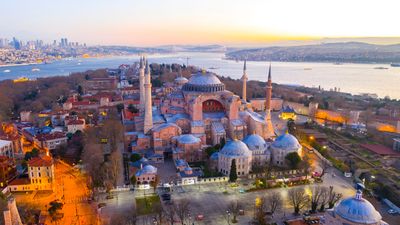
One unusually unexpected example is Hagia Sophia, a stunning mosque in modern-day Istanbul, Turkey's largest city.
"Halfdan was here"
In 1964, a line of faded graffiti was discovered on a marble slab on the top floor of the southern gallery of the Hagia Sophia by Swedish rune expert Elisabeth Svärdström. Many of the symbols were illegible, but she deduced they were runes with one readable part – “ftan” – that possibly alludes to the Nordic name “Halfdan”.
Some have gone as far as to suggest it once said “Halfdan carved these runes” – in other words, “Halfdan was here.”
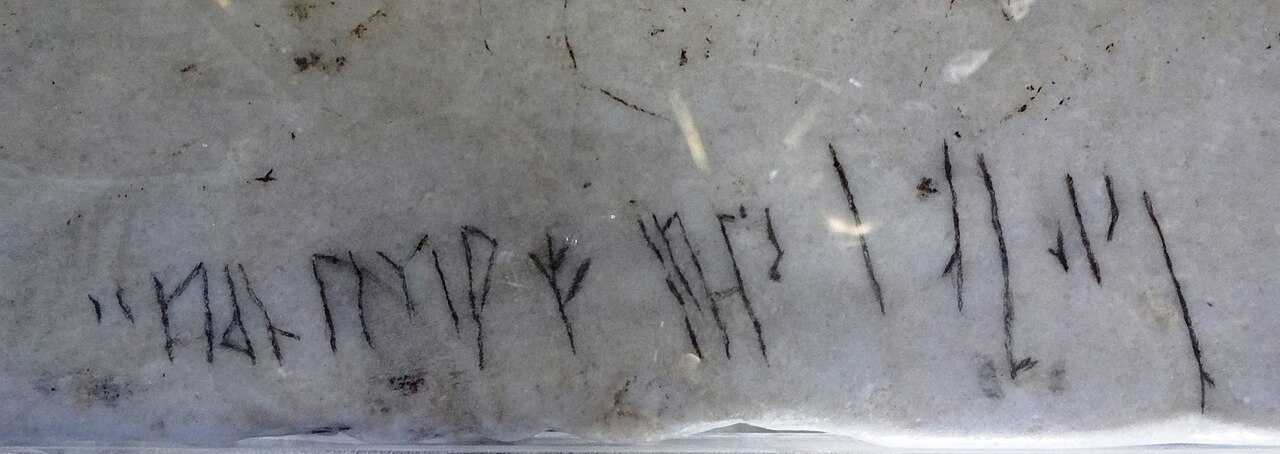
A second runic inscription was discovered in 1975 in the northern part of the same gallery. An interpretation years later suggested it read “Ári m(ade)” or “Ári m(ade the runes)” – in other words, “Ári was here.”
But what were some Viking graffiti writers doing here on the Anatolian Peninsula, some 2,400 kilometers (1,491 miles) away from their motherlands in Scandinavia, around 1,000 years ago?
The winding history of Hagia Sophia
As it turns out, Hagia Sophia wasn’t always a mosque. It was converted into an Islamic place of worship in 1453 CE after Constantinople, the capital of the Eastern Roman Empire (AKA the Byzantine Empire), was conquered by the Ottoman Empire.
It briefly became a secular museum from 1935 to 2020, but was recently revived for Islamic worship after a Turkish court reversed that decision. Today, non-Muslim tourists can visit the upper gallery level to soak in the history, while the main ground floor is reserved for Muslim worship.
It started life in 360 CE, centuries before Islam emerged, as a church built on the grounds of a pagan temple (as many old churches often were). It was destroyed by flames twice (as many old churches often were) during its early history before being magnified into a grand cathedral in 537 CE under Justinian I of the Eastern Roman Empire.
Vikings in Constantinople
The Vikings had many ties to this empire, located in the eastern Mediterranean region, through both trade and war.
Scandinavian Rus warriors, who had settled along the rivers between the Baltic and the Black Sea, raided Constantinople in 860 CE. Eventually, the bad blood settled, and some of these men formed an elite unit of the Byzantine army, the Varangian Guard, who served as personal bodyguards for the emperors.
Many attribute the graffiti in the Hagia Sophia to those axe-wielding warriors, although plenty of other Norsemen would have passed through Constantinople too, as merchants, diplomats, or political exiles.
In typical Viking fashion, they didn't leave behind a trove of physical evidence here, just a couple of scrawled bits of graffiti to say "we were here."

 1
1