Humans
 PUBLISHED




Today, it is well known that the Vikings reached the shores of North America hundreds of years before Christopher Columbus even set sail. For decades, this reality was not well known outside of a few academic circles, but recent archaeological developments and media attention have helped establish the story. So what do we know about this remarkable feat of seafaring and exploration history?
Hints that Vikings settled in North America first emerged from Icelandic sagas, a genre of Medieval literature that usually focused on stories associated with specific families and their heroic genealogies. Most Icelandic sagas were first set down in writing during the 13th and 14th centuries, but the tales they record often relate to events that occurred during the eighth to the 11th centuries.
The extent to which these sagas are realistic accounts of the people they concern or just a form of historical fiction is debatable, but they nevertheless provide valuable insights into the world of medieval Norse peoples.
Through them, we not only learn about important individuals and their lives, but also the things they held dear, such as honour, and ideas about revenge and justice. We also learn about their great adventures and even their voyages to distant places, including an unusual place they called “Vinland”, far to the west of Greenland.
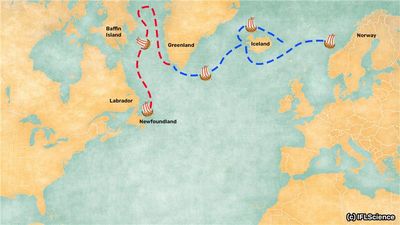
The accounts concerning Vinland (Vineland, or Winland, meaning the “land of wild vines”) are contained in two separate sagas, the Saga of the Greenlanders and the Saga of Erik the Red. Although both accounts are short and contradictory, they nevertheless describe the same route taken by travelers initially blown off course.
The route goes like this: Two days west from Greenland there is a country of flat stones called they called Helluland (thought to be Baffin Island). From here, the route goes south past Markland, a stretch of beaches covered in coastal forest that may be modern Labrador. The journey continues from here to Vinland, which is believed to be Newfoundland.
Exactly who was the first person to step foot on the Vinland soil is unclear from these accounts. In the Saga of the Greenlander, the more credible of the two sources, we see a complex narrative of discovery and subsequent revisits. According to this version, the Viking hero, Leif Eriksson, is the first to make landfall. Eriksson then founds a settlement called Leifsbuðir, which serves as a base for future travelers.
In the Saga of Erik the Red, there is only one journey to Vinland and Eriksson merely sights the land. It is the trader Thorfinn Karlsefni and his wife Gudríd who attempt to settle, along with 160 others.
Taken as a whole, and discarding the contradictions, we get a picture of multiple voyages to Vinland from recurring names. It also seems that the travelers likely set up multiple places, with temporary settlements and waystations.
But was this really “undiscovered” terrain? National Geographic has provided a valuable reminder that this narrative about Viking exploration should not eclipse the fact that Vinland was already inhabited. The Sagas mention people, referred to as “Skraelingar”, a derogatory word for “savages” living there already.
In both sagas, the interactions between the Viking settlers and the local First Nations communities are strained and eventually violent. In fact, the Norse settlers are eventually forced to flee because of resistance to their presence.
Ultimately, the journey to the west, however it played out, was only a temporary affair that lasted a few years at most. With time, it completely faded from memory, becoming just another feature of the Sagas. Today, our knowledge of this expedition continues to grow, as does our understanding of Viking culture more generally.
[H/T: National Geographic]