


 Humans
 PUBLISHED


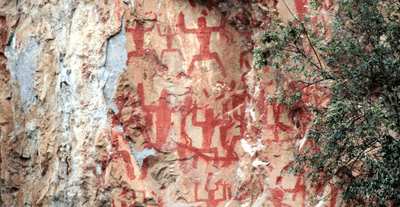


For decades, researchers have wondered how vivid red rock art in China’s Zuojiang River Valley has managed to withstand the onslaught of repeated monsoons without fading. Created around 2,000 years ago, the paintings remain largely intact, and the reason may be down to the use of human blood to help bind the pigment to the limestone rock face.
Located in the Zuojiang Huashan Rock Art Cultural Landscape, the artworks were composed by members of the Luoyue culture between 2,600 and 1,900 years ago. Among the images are depictions of sexual intercourse, pregnant women, and male genitalia, all of which are thought to be linked to an ancient fertility cult.
Yet the remarkable preservation of these open-air murals needs explaining.
“The fact is that the Huashan rock art has survived for over two thousand years in a subtropical monsoon climate,” write the authors of a new study. “No natural organic binder can have lasted for such a long time in such humid conditions.”
To investigate, they used a series of chemical analyses to reveal the ingredients in the ancient paint. The first thing the team noticed was that the pigment was so strongly bonded to the rock that samples had to be removed using a power drill.
Results indicated that the illustrations consisted of two layers. First, the artists laid down a primer binder, which they made by heating ingredients such as animal bones, bird droppings, limestone, and shells, in order to obtain a mixture of calcium phosphate and quicklime.
Water and blood were then added, creating a liquid mortar that the pigment could later bind to.
Once this was applied to the rockface, the artists then waited for it to begin drying before painting over it with a red pigment layer made from local clay containing high levels of iron oxide.
The key to the whole process, however, was the blood proteins, as these “biomineralized” the calcium carbonate in the mortar layer, effectively turning it into the same material as the limestone cliff on which it was painted. As the tiny pigment particles became encapsulated inside the biomineralized calcium carbonate, they permanently fused with the rock face.
“This stable organic-inorganic composite bonding system reveals the complex technological processes used by the creators and explains why the Huashan rock art has survived so well in such challenging conditions for over two millennia,” write the study authors.
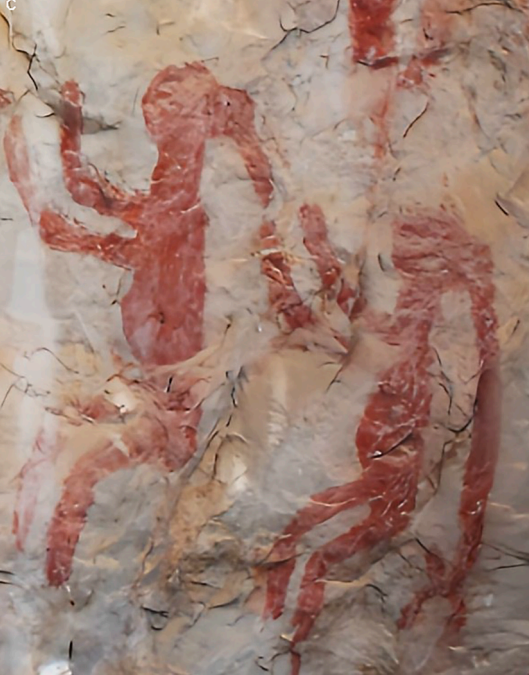
At one of the studied sites, the researchers found that the mortar layer contained 97 to 99 percent human blood, with the remaining one to three percent coming from several species of herbivorous animals. A separate sample, meanwhile, consisted of 61 percent human blood and 39 percent bovine blood.
Looking more closely at the human blood, the study authors noted that it contained prolactin-inducible protein and lactotransferrin, both of which are barely present in most people but increase dramatically in heavily pregnant and lactating women. Given the nature of the imagery and the fact that the Luoyue were matriarchal, the researchers suggest that the blood may have been collected during childbirth and added to the murals as some sort of fertility rite.
“The blood used may come from the females who gave birth, which could be linked to the worship of female fertility of the creators' community, a matriarchal fisher-hunter-gatherer society,” they write.
The study is published in the Journal of Archaeological Science.




 8
8