Humans
 PUBLISHED





Archaeologists have returned to the Cave of the Venuses, a prehistoric site in Europe once home to both Neanderthals and some artistic Homo sapiens. After using a new combination of techniques to analyze the cavern's interior, the team believes it could harbor even more discoveries.
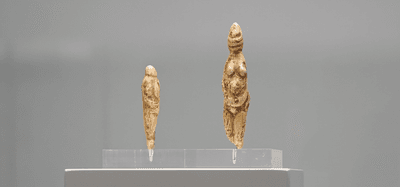
The Cave of the Venuses (Grotta delle Veneri) is found near Parabita, a sleepy town on the heel of Italy’s boot. It earned its name after archeologists working at the site discovered two “Venus figurines,” small statuettes of female figures carved out of animal bone.
The mystery of Venus figurines
Dated to around 20,000 years ago, both depict a human body with breasts and arms that wrap under the belly, suggesting they might represent pregnant women.
In the larger figure (around 9 centimeters, or 3.5 inches) the face is obscured by a series of deep grooves, perhaps used to depict a veil, mask, or hairstyle. The smaller figure (just over 6 centimeters, or 2.3 inches) was crafted in a very similar style, but with less detail.
Strangely, very similar Venus figurines can be found across Europe. One of the oldest (and arguably the most beautiful) examples is the Venus of Willendorf, unearthed in Austria and carved from Italian rock. Theories on what they were range from spiritual talismans or good luck charms for fertility to lustful expressions of beauty. Maybe they depict a goddess.
It’s a mystery how and why this artistic style became so widespread across vast distances and over thousands of years, but it suggests these figurines held deep cultural significance.
This pair discovered in southern Italy are particularly unusual because they blend a variety of aesthetics found across Europe: the bodies are in the Mediterranean style, the faces are in the Rhine-Danube style, and the pose is reminiscent of figurines more commonly found in Russian.
The Venus figurines are the work of Homo sapiens, but older artefacts found in the cave suggest it was also once inhabited by Neanderthals. This was an important discovery, the researchers report, as it provided evidence that this extinct group of humans lived in this part of the Mediterranean.
Hidden cavities in the Cave of the Venuses?
In a new study, archaeologists at the University of Malta and the Institute of Heritage Science in Italy surveyed the Cave of the Venuses using ground penetrating radar and electrical resistivity tomography, a technique that pulses electricity through the ground and measures how easily it flows.
This picked up signals the researchers are calling “anomalies,” which suggest there are several previously unknown cavities near the cavern that may be connected to the main cave. Without digging, it’s uncertain whether the cavern truly does connect to these long-lost cavities, but it wouldn't be the first time a discovery like this has been made.
In 2021, another team of archaeologists discovered a hidden chamber at the back of Gorham’s Cave Complex in Gibraltar, also on the Mediterranean coast. Measuring 13 meters (42 feet) deep, the chamber had been sealed for 40,000 years and contained a variety of artefacts that highlight the life of Neanderthals just before their extinction
Of course, there’s no indication that the Cave of the Venuses will harbor similar surprises, but the example from Gibraltar goes to show that even well-studied caves can reveal new secrets when researchers go hunting for them. The researchers of this latest study believe their combination of techniques may be the way forward.
The new study is published in the journal Digital Applications in Archaeology and Cultural Heritage.