Humans
 PUBLISHED
 1
1





As a writer at a science website with a bit of an interest in history and the absurd, you come across a fair few stories of people who perform experiments on themselves.
Sometimes these are highly misjudged, sometimes they involve a bit of a fight with a nurse. Other times it turns out their theory didn't really pan out, and they contract gonorrhea and syphilis for no reason at all.
Generally though, these experiments tend to be the most important thing the person involved ever did. Hey, look at this egghead whose main thing was they figured out how Ebola spreads by eating a big pile of poop. That sort of thing.
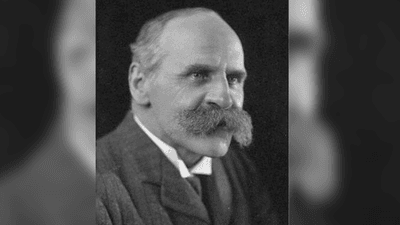
John Scott Haldane is a rare example of someone who achieved so much during his 76 years that people barely get time to mention how he was huffing dangerous gases like there was no tomorrow. But huff he did, and heavily.
History of a notorious gas huffer
Haldane was born to a fairly rich family in Scotland and became a physiologist with an overall mission to help others. As a scientist, he believed "the aim of the science of physiology is to deliver general principles which shall enable us to predict behaviour of the living body under various physiological conditions," and his work reflects that pretty well.
Some of his most notable contributions came in investigating coal mining disasters and the toxic gases that killed people following mining explosions. As well as designing respirators, he introduced the practice of sending small animals into mines ahead of the miners.
This is the origin of the idea of the canary in a coal mine: if dangerous gases were present, the small animal would alert the miners by being dead or dying when it was brought back up.
On top of this (before we get into the self-experimentation), he also did a lot of work on decompression during diving, with his discoveries still widely informing diving today.
Plus, during World War I, he put his significant talents towards developing an early gas mask, protecting troops from quite horrible deaths at the hands of chlorine, phosgene, and mustard gas.
So, a lot of achievements. But he did also have a bit of a penchant for testing dangerous gases on himself and loved ones.
"Haldane liked nothing better than to explore dangerous mine shafts and sewers. But it was in the specially constructed, air-tight chamber in his lab that the effects of gases on people were revealed," a paper explains.
"In an age before risk assessments, institutional review boards and human subject ethics committees, Haldane was a serial self-experimenter. He also thought nothing of exposing his own son Jack to dangerous doses of chlorine and other noxious gases."
"His young daughter Naomi once told a six-year-old friend outside their house: 'You come in. My father wants your blood.' Her friend screamed and ran away."
After one experiment, he was supposedly stopped by a police officer in Oxford, who had presumed him to be quite drunk. Haldane informed the officer that he had simply been inhaling some gas, which we're sure cleared that situation right up.
In one particularly dangerous, but by no means atypical, experiment, he had someone (himself, of course) inhale carbon monoxide gas to document the effects.
"He made these experiments on himself, and recorded the symptoms which he experienced and the degree to which the haemoglobin of the blood became saturated with the gas when this was present in different concentrations in the air breathed," an obituary takes the time to explain.
"At the same time he devised a simple method for determining the degree of saturation of the blood with carbon monoxide and added considerably to the knowledge of the interaction between haemoglobin and this gas or oxygen."
It also appears that Haldane was a fan of evening things out a bit. As well as taking on a lot of gas, he led an expedition to Pike's Peak in Colorado in order to study the effects of high altitude and a thinner atmosphere on oxygen secretion.
For many, that would be a grueling task. For Haldane, who clearly had a lot of gas to get back to, it must have been excruciating.