Humans
 PUBLISHED




Prehistoric communities on the Japanese island of Kyushu lived through one of the largest volcanic eruptions of the Holocene when the underwater Kikai volcano blew its top 7,300 years ago. Until now, archaeologists had assumed that the catastrophe wiped out local hunter-gatherer populations, but new research suggests that this may not be the case.
Located some 30 kilometers (18.6 miles) south of Kyushu, beneath the East China Sea, the volcano released a series of scorching pyroclastic flows that rapidly spread over the sea and across the island, incinerating everything they touched. Known as the Kikai-Akahoya (K-Ah) eruption, this devastating event triggered a range of additional impacts, including “massive tsunamis, powerful earthquakes, and thick deposits of volcanic ash.”
However, analyzing archaeological data from across Kyushu, the authors of a new study suggest that the island’s population of Jōmon hunter-gatherers did not perish in the disaster. Instead, survivors moved from the south to the north of the island, where their culture continued to thrive and expand in the aftermath of the eruption.
“The demographic model partially aligns with the argument that K-Ah triggered a “Jōmon Apocalypse,” at least in southern and central Kyushu,” write the researchers. “These regions suffered major damage, extensive depopulation, and, in several areas, an enduring cultural hiatus.”
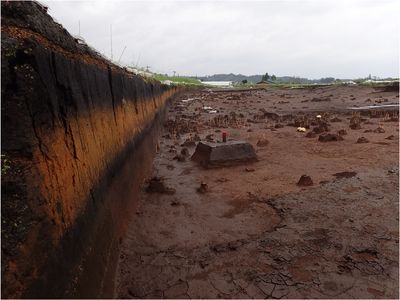
To give an example, the authors highlight an archaeological site in Numerikawa, where abundant pottery has been retrieved from layers of sediment predating the eruption. These are covered by a layer of volcanic debris, above which no further pottery is found, suggesting that no one at this site survived the catastrophe.
However, the researchers also note that slit stone earrings are found in southern Kyushu prior to K-Ah, and then began to appear further north immediately after the event, where they proliferated in number. This suggests that some people who lived close to the undersea volcano did survive, and moved to the north of the island.
“Our demographic modeling confirmed population growth continued in northern coastal Kyushu after the eruption,” explain the study authors. “This population trend may have been boosted by refugees abandoning southern Kyushu and moving northward.”
As more and more people arrived in the north of the island, new social networks and cultural dynamics formed, resulting in the emergence of a new pottery complex known as the Sobata tradition.
At the same time, the growing northern population began expanding its maritime hunting practices, with stone harpoons appearing across northern Kyushu and its nearby islands shortly after K-Ah.
Taking all of this evidence together, the researchers conclude that “Jōmon societies in Kyushu neither 'collapsed' entirely nor simply 'survived'. Instead, the eruption triggered a range of demographic consequences and responses, with high fatality and abandonment rates in the south of the island and considerable population growth in the north.
The study is published in the journal Science Advances.