Humans
 PUBLISHED






In 1873, the renowned Argentine sailor Luis Piedra Buena led an expedition across one of the world’s most dangerous stretches of water.
The expedition was bound for the Isla de los Estados, which sits off the very southern coastline of Patagonia. Traveling aboard the schooner brig “Espora”, the team were hoping to hunt the island’s penguins for their oil.
To reach the colony, however, the Espora had to cross the notorious Strait of Le Maire, which was feared for its strong winds and lethal currents, and was already littered with shipwrecks.
Fortunately for the penguins that the crew set out to hunt, Piedra Buena’s ship sank, forcing the sailors to survive as castaways at the southern tip of the inhabited world.
Castaway camp
According to Piedra Buena’s account, the Espora sank in the Lacroix Inlet, which is located in a region of Isla de los Estados known as Franklin Bay. Here, he and his crew lived as castaways while they built a makeshift cutter, which they eventually used to sail to Punta Arenas in Chile.
Traveling to Franklin Bay in January 2026, a team of researchers discovered a nineteenth-century shipwreck along with the remains of a “possible castaway camp”.
“The location and material culture of the temporary occupation at Lacroix Inlet point to a connection between this site and the nearby shipwreck remains and thus, possibly with the Espora and her crew,” write the authors of a new study.
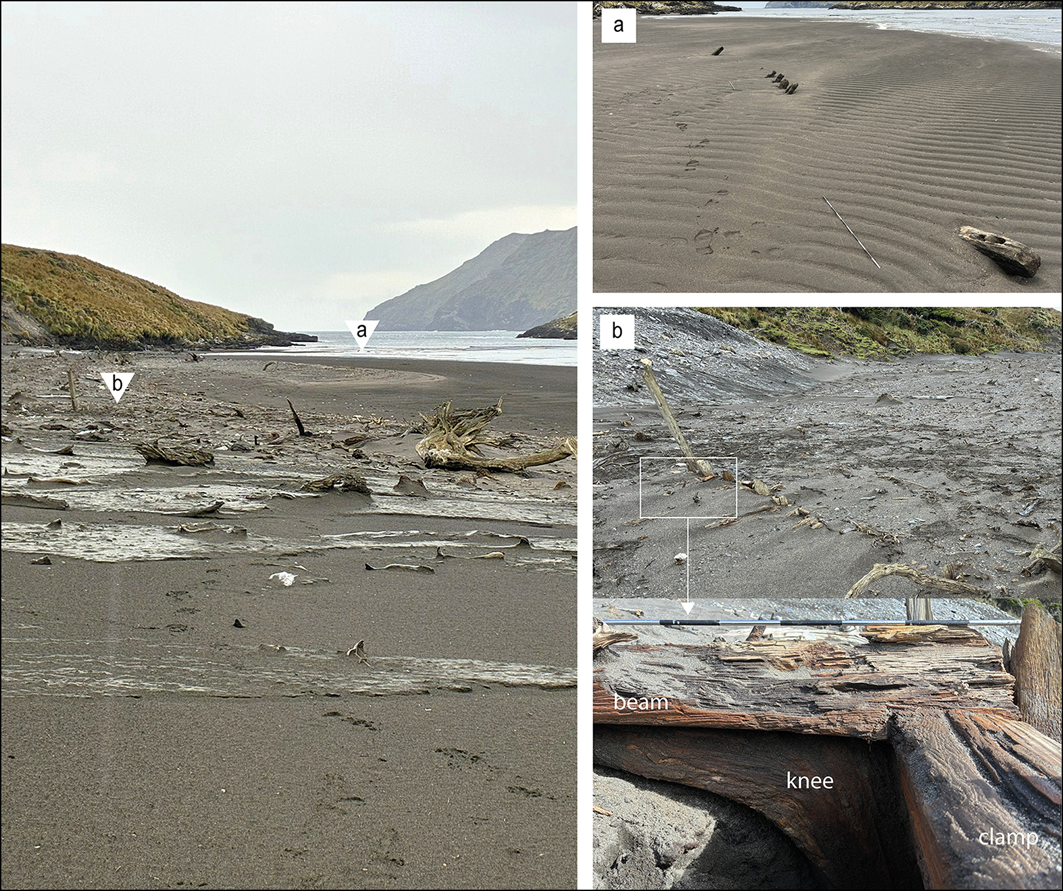
Among the most significant finds are three wooden structures that were all once part of the hull of a ship, although at this stage it is impossible to say if all three belonged to the same vessel. The researchers therefore call for a comprehensive study of the architectural features of these three fragments to determine their age, provenance, and function.
But near the wreck, the team also located what they describe as “the remains of a short-term occupation” by the side of a steep hill. Here, they identified a range of personal items including beads, buttons, and a bottle, as well as nautical tools such as a deck prism and a rudder hinge.
According to the researchers, the presence of these objects “attests to at least one naval accident that led to a temporary settlement” on Isla de los Estados during the 19th century.
And while the authors suspect that their discoveries may correspond to the shipwrecked penguin hunters of the Espora, they caution that further analyses are required before this connection can be confirmed.
“The identity of the vessel/s and the castaways’ trajectories are the subject of ongoing inquiry,” explain the researchers.
The study has been published in the journal Antiquity.