


 Humans
 PUBLISHED





What you'll discover in this article...
- The remains of Ancient Egyptian princesses were discovered in Dahshur, Egypt, buried with weapons.
- "Signature" marks on their skeletons reveal they used these weapons in life, with the intense training leaving a legacy in the shape and condition of their bones.
- As study author Zeinab Hashesh told IFLScience: "These princesses were not passive, decorative figures; they were well-conditioned athletes whose bodies were hardened by the same disciplined force as the men of their time."
In the 1890s, a funerary complex of pyramids and tombs was discovered in Dahshur, Egypt. Amidst the crumbling remains of this necropolis were six mummies, five of which were female.
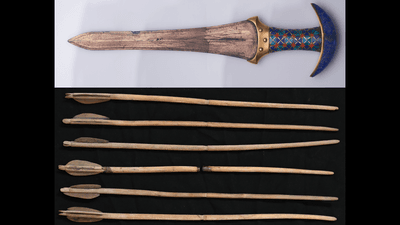
These Egyptian princesses were buried alongside weapons such as daggers and arrows, an unexpected find when such items have historically been used to identify which Ancient Egyptian remains are male. It raised the question: were these weapons ornamental grave goods for the afterlife, or something else?
Searching for (scattered) clues
Four presumed sisters (Princess Ita, Khenmet, Itaweret, and Sathathormeryt) were buried in matching underground chambers. A fifth princess, Noub-Hotep, was found elsewhere at the Dahshur site in a chamber associated with King Hor, though her exact relationship to him isn't yet known.
Their remains are in the region of 3,800 years old, and, suffice to say, time has taken its toll. Much of their soft tissues have turned to powder, and it's thought that their skulls were lost after the remains were exhumed in the early 1900s.
Still, the skeletal elements that remain tell a fascinating story that defies historical assumptions about gender roles and grave goods.
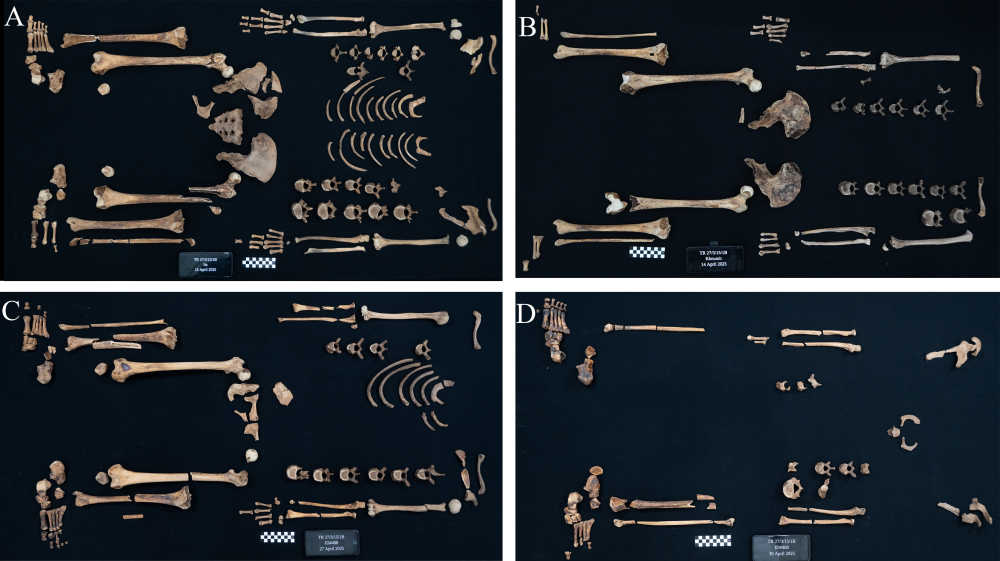
Their skeletal remains provide a biological record of habitual, high-intensity mechanical loading.
Zeinab Hashesh
"Our research revealed that archery and weapon practice among the Middle Kingdom elite was far more than a mere status symbol or recreational ‘hobby’," study author Dr Zeinab Hashesh at Beni Suef University in Egypt told IFLScience.
"While we cannot definitively prove these princesses stood on a formal battlefield, their skeletal remains provide a biological record of habitual, high-intensity mechanical loading that possibly occurs through years of disciplined training."
Reading the skeletal record
Bioarchaeology is the study of human remains in archaeological contexts. Much like reading the fossil record, it provides an incomplete snapshot into ancient lives.
A critical clue it can search for is the way human activities have shaped a skeleton. Like osteological "signatures," these individual differences can reveal how a person used their body in life.
We identified specific ‘signatures’ of skilled force, most notably the ‘Archer’s Grip’.
Zeinab Hashesh
Certain activities give rise to known patterns of skeletal changes, and that’s exactly what scientists are looking for.
"We identified specific ‘signatures’ of skilled force, most notably the ‘Archer’s Grip’ in Princess Noub-Hotep," said Hashesh. "This is a unique structural bowing of her second right metacarpal (a palm bone), which is a permanent biomechanical response to the intense pressure required to stabilize a heavy bow during its use."
"Furthermore, Princesses Khenmet and Itaweret displayed pronounced muscle hypertrophy at specific forearm sites required for repeated bow-drawing, while Princess Ita showed exceptional robustness in muscle attachments responsible for the precision gripping of weapons like daggers or maces."
Signatures of strength
These osteological clues represent rare evidence that weapons found in the burial chambers of female mummies weren’t just symbolic tokens to be taken into the afterlife. These women most likely used them in their roles as “active ritual agents” that partook in elite hunting and enforced the Ancient Egyptian concept of Ma’at (divine order) through ceremonial displays of power.
"These princesses were not passive, decorative figures; they were well-conditioned athletes whose bodies were hardened by the same disciplined force as the men of their time," said Hashesh.
This bias effectively made martial or athletic women 'invisible' in the archaeological record for over a century.
Zeinab Hashesh
"It proves that in the elite royal sphere of Dahshur, high social status could ‘redefine’ or expand expected gender roles."
The reanalysis challenges assumptions in archaeology that have historically seen weapons in burial chambers as an indicator of male sex. Meanwhile, females were associated with jewelry.
"This bias effectively made martial or athletic women 'invisible' in the archaeological record for over a century," said Hashesh.
Here, we have compelling evidence that not only were these royal women buried with weapons, but that they seriously knew how to use them. A discovery that shifts our understanding of gender roles and ancient burial practices and demonstrates there's so much more value to grave goods than their worth as treasure.
The study is published in the journal Frontiers in Environmental Archaeology.


 1
1