Space and Physics
 PUBLISHED
 1
1


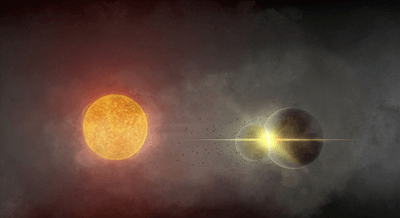


Strange variations in the light from a distant star have been attributed to the dust thrown up by a giant collision remarkably similar to the one that produced the Moon.
It is generally accepted that around 4.5 billion years ago, a Mars-sized planet known as Theia slammed into the Earth, throwing up the material that eventually coalesced into the Moon. Although the early Solar System was marked by impacts between large bodies, this event appears to have been without a parallel. When people ask what makes the Earth distinctive enough to produce a technological civilization in a galaxy where they appear rare, this impact gets plenty of consideration.
Consequently, it would be great to know how often similar impacts occur to other Earth-like planets. That’s probably not something we’ll really be able to answer until we have telescopes capable of reliably detecting exomoons, moons orbiting planets in other star systems. Sometimes, however, luck can offer us more information than we had any right to expect, and it seems that happened 10 years ago.
University of Washington graduate student Anastasios Tzanidakis was looking through old telescope data when he noticed something very odd about Gaia20ehk, a star 11,000 light-years away no one had paid much attention to previously. An F-type star, Gaia20ehk, is 30 percent more massive than the Sun, and apparently a lot younger, but it is still old enough to have reached the stable stage of its life.
"The star's light output was nice and flat, but starting in 2016 it had these three dips in brightness. And then, right around 2021, it went completely bonkers," Tzanidakis said in a statement. "I can't emphasize enough that stars like our Sun don't do that. So when we saw this one, we were like, 'Hello, what's going on here?'"
The fluctuating light curve didn’t look like KIC 8462852, also known as Boyajian's star, which achieved fame in 2015 with speculation of being shielded by alien megastructures, but the behavior was at least as unusual for a star well onto the main sequence. However, where a dozen explanations were offered for KIC 8462852, in the case of Gaia20ehk, Tzanidakis and colleagues had none, until they looked at infrared images of the same star.
"The infrared light curve was the complete opposite of the visible light," Tzanidakis said. "As the visible light began to flicker and dim, the infrared light spiked, which could mean that the material blocking the star is hot—so hot that it's glowing in the infrared."
A sudden burst of hot dust is what you would expect from a head-on collision, but the pattern Tzanidakis had found was more complex, with smaller amounts released first.
"That could be caused by the two planets spiraling closer and closer to each other," Tzanidakis said. "At first, they had a series of grazing impacts, which wouldn't produce a lot of infrared energy. Then, they had their big catastrophic collision, and the infrared really ramped up."
The uncanny thing about all this is that the dust is orbiting Gaia20ehk at a distance of about 165 million kilometers (100 million miles), just slightly greater than the distance the Earth orbits the Sun. That means the light from Gaia20ehk won’t be sufficient to keep it hot, and will eventually cool to the point where much of it condenses, probably into a moon of the planet that took the hit. The dust mass is less than 1 percent of the mass of the Moon, but larger objects within it would be undetectable because they are not spread out the way the dust is.
The timeline for this process is unknown. Much of it will be invisible to us – given the distance, this is not a system in which we can observe planets directly, even those that are temporarily very hot.
"It's incredible that various telescopes caught this impact in real time," Tzanidakis said. "There are only a few other planetary collisions of any kind on record, and none that bear so many similarities to the impact that created Earth and the moon. If we can observe more moments like this elsewhere in the galaxy, it will teach us lots about the formation of our world."
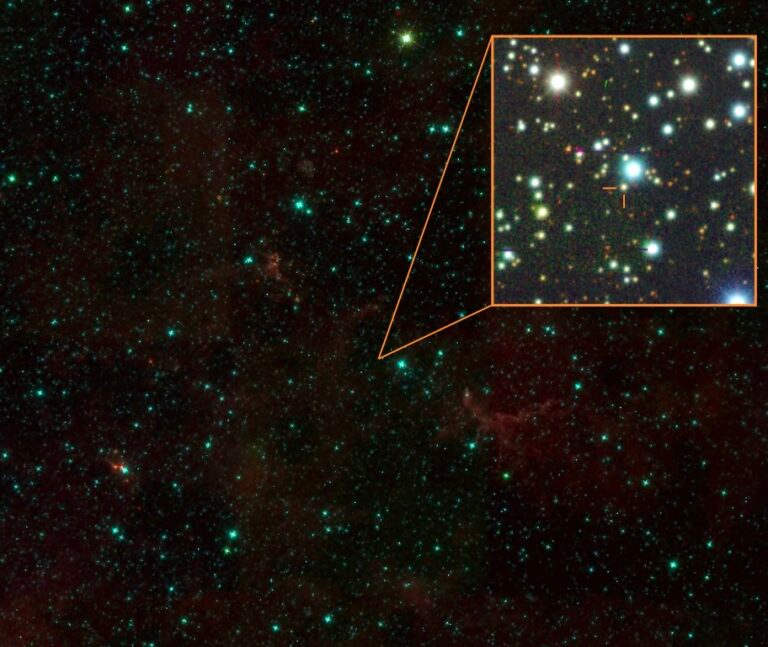
Remarkable as this event was, finding it was not pure luck, being also a product of the unusual PhD topic Tzanidakis has chosen. He is investigating records of stars obtained by the Gaia space telescope and looking for examples of extreme variability over periods of a decade or more. "Not many researchers are looking for phenomena in this way, which means that all kinds of discoveries are potentially up for grabs,” said senior author Dr James Davenport.
Those opportunities will increase as extended data from the Vera Rubin Telescope becomes available, dramatically upping the number of stars whose variations we can see.
"How rare is the event that created Earth and the Moon? That question is fundamental to astrobiology," Davenport said.
"It seems like the Moon is one of the magical ingredients that makes Earth a good place for life. It can help shield Earth from some asteroids, it produces ocean tides and weather that allow chemistry and biology to mix globally, and it may even play a role in driving tectonic plate activity. Right now, we don't know how common these dynamics are. But if we catch more of these collisions, we'll start to figure it out."
The study is open access in The Astrophysical Journal Letters.