Space and Physics
 PUBLISHED
 3
3



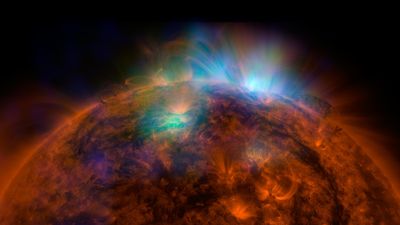


If the Sun were very different, we wouldn’t be here. A shorter-lived star wouldn't provide the opportunity for humanity to develop, a star that was more erratic would regularly fry us, and stars in close binaries come with their own problems. Is the reason we haven't heard from aliens because the Sun is one of only a handful of stars in the galaxy capable of supporting a space-faring civilization? Rather than looking for Earth 2.0, should we be looking for Sun 2.0? The short answer is no one knows, but it's an interesting idea to consider.
Just my type?
The Sun is a G-type star, which is a classification based on its color and temperature. When astronomers first started seriously thinking about life elsewhere in the universe, it was natural to focus on G-type stars as the places to host them. After all, if it can happen once, we know it can happen twice.
There are 100-400 billion stars in the galaxy, and 8-10 percent of them are estimated to be G-type. So if all we needed for life was a G-type star, there are between 8 billion and 40 billion of them in the Milky Way.
That’s overly simplistic for reasons we will discuss, but it’s a good place to start.
Probably the most crucial thing a star can offer its planet in terms of intelligent life, after its light, is time. The more massive a star is, the faster it burns through its fuel and dies. Even before its death, stars undergo enormous expansions during their giant phase. Many planets that might have had the capacity to host life burn up inside their star. Others find themselves orbiting not far from the surface and become absurdly hot. Planets further out may become newly habitable, but not for long.
O-, B-, and A-type stars all have pre-giant phases that are so short it’s questionable whether life on a planet circling them could even get started. F-type stars survive for longer, and it wouldn’t be surprising if many of them had planets with life, albeit further out from the star than Mars is from the Sun. Nevertheless, an F-type star born at the same time as the Sun would have reached its giant phase by now. Life, therefore, would need to have moved a lot faster if it wanted to develop spaceships and radio telescopes before being burned to a crisp.
There might be some way this could happen, but there are plenty of reasons to be skeptical. Life seems to have appeared on Earth almost as soon as the planet was cool enough to support it. Our ancestors spent a very long time as single-celled organisms, but there was a good reason for that: the oceans, when they appeared, couldn't support anything else. It took billions of years of photosynthesis before oxygen levels allowed life to get more complex. Unless the microbes on a planet orbiting an F-type star work out how to do that substantially faster, they’re probably not getting to trilobites, let alone dinosaurs, before being cooked.
At the other end of the scale, M-type and K-type (dwarf) stars might be better bets, but that’s still a topic of much debate. These stars certainly live long enough for life to evolve, but there are other concerns, including a smaller habitable zone, increased chance of having tidally locked planets, and higher levels of harmful radiation. That just leaves G-type stars.
All G?
Not all main-sequence G-type stars are alike, however. The Harvard spectral classification divides them into 10 subgroups, from G0V to G9V. The Sun is a G2V star. If you suppose life needs a star of the exact same sub-category, there might be fewer than a billion of them in the entire galaxy. This is probably too prescriptive, however. G0V stars have shorter lifetimes than the Sun, to the extent they might be a bad match, but the other categories are so similar that there’s no obvious reason life wouldn't have plenty of time to evolve.
In some cases, though, other parameters would need to be a little different. A G9V star is only a little over half as bright as the Sun, for example. At the same distance as it is around our Sun, Earth would be frozen solid around a G9V star, but a planet with an Earth-like atmosphere and an orbit similar to Venus's should do just fine.
The perks of being single
The Sun travels the galaxy solo, aside from its planets and a bunch of other debris, but that’s far from universal. It used to be thought the majority of stars are paired up in binary systems, with some in more complex arrangements. While that has been somewhat called into question more recently, there are still likely to be billions of solo G-type stars, maybe more than 10 billion.
There’s plenty of debate about how important this is. Many binary stars are so distant from each other that their interactions might be limited. If the Sun had a companion star tens of billions of kilometers away, like Rigel’s companions, it might not interfere with the chances of life, but then again there might be effects we don’t know about, such as more frequent bombardment with comets. So while astrobiologists aren't writing off the prospects of aliens coming from multi-star systems, Three-Body Problem style, if we want a truly Sun-like star, it might be best to leave them out.
That’s metal
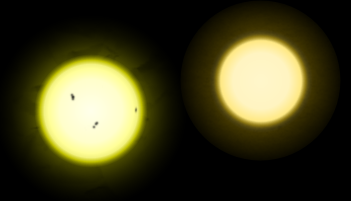
Stars start off as mostly hydrogen, which they gradually convert to helium. However, stars that aren't part of their galaxy’s first generation are born with small amounts of other elements in them, seeded by supernovae and other dying stars. Astronomers, to the amusement of other scientists, refer to all elements heavier than helium as “metals” and call the abundance of these elements a star’s metallicity.
Keeping track of almost a hundred elements gets a bit hard, so in most cases metallicity is measured by the ratio of iron to hydrogen in the star, which is considered among the most important stellar metrics.
We are fairly confident that a star’s metallicity is important for the chances of life. The planets were formed from the same cloud of elements as the Sun. A star with very low metallicity is considered unlikely to have Earth-like planets, because there wouldn’t be enough iron and silicon left over to make a large world.
Too much metallicity may also be a problem, as it could be connected with the formation of lots of wildly orbiting gas giants. However, we don’t know where the cut-off point might be on either side.
Without knowing how narrowly we need to draw the boundaries around stellar metallicity, it’s hard to know how much this cuts our list of candidates down. Nevertheless, there are certainly hundreds of millions, maybe billions, of stars that meet all the previous criteria and have metallicity quite close to the Sun’s.
Location, location, location
The Sun orbits the center of the galaxy at a distance of about 27,000 light years in the Orion Arm. At least to some extent, this location is one of the things that make it special. A star close to the densely packed galactic center probably couldn't support advanced life because it would experience frequent encounters with other stars, some much larger and brighter than itself.
A star system near the center of the galaxy would also often be blasted with radiation from supernovae, and its planets might frequently have their orbits adjusted by another star’s gravitational pull, or in various other ways be made quite unsuitable.
Being further out is probably not an obstacle for alien evolution on its own, but as you get out towards the very edge of the galaxy, metallicity tends to drop. Consequently, some astronomers have argued we can’t expect any aliens we might encounter to come from much further out.
Once again, however, it’s hard to put a figure on this. Is a star half the Sun’s distance from the center of the Milky Way too close? What about two-thirds or three-quarters? Without the answers, we can’t know how many stars survive this new test, but it’s probably in the millions.
What else matters?
Even if there is another star with a suitable lifespan, location, metal content and lack of a stellar companion, would it just need a well-paced Earth to produce advanced life? Or is there some other solar attribute that matters? Again, we don’t know. For example, some stars are more prone to large flares than others, and being frequently bombarded with immense bursts of radiation is probably not the cradle you want.
We know lower mass stars tend to be more given to flares than G-type stars, which is one reason not everyone is convinced M and K-type dwarf stars are where it’s at. However, two stars with similar masses can show very different flare behavior, and the reasons for this are still mysterious. It’s possible the Sun is also special by virtue of being unusually calm, or unique in some other way we are yet to determine.