


 Space and Physics
 PUBLISHED



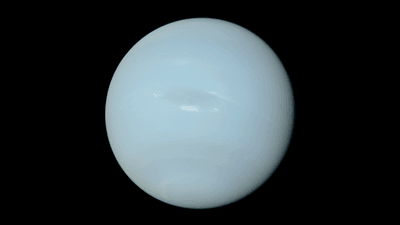


Uranus and Neptune are the only two planets in the Solar System that have only been visited once by spacecraft, both in literal flying visits as the Voyager 2 probe zipped past them during its Grand Tour. That was in 1986 for Uranus and 1989 for Neptune, so it’s about time we got back there, ideally to place an orbiter around one or both of them.
The two planets are commonly referred to as ice giants, but we know so little about them that even that concept has recently come into question. Uranus has a truly bizarre magnetic field, and it orbits on its side, likely as a result of a colossal impact billions of years ago.
Uranus's moon Miranda has the biggest cliff in the entire Solar System, which may reach a height of 20 kilometers (12 miles). Neptune has ever-changing storms, and its largest moon, Triton, is a geologically active world with cryovolcanoes. If you ask us, these are must-see sights. Don’t just take our word for it, though.
"Really, the case for a big mission, an orbiter to both Uranus and Neptune, I think is so overwhelming! If I was one of these billionaires… just floating around with all my money, I would fund two missions: I'd fund an orbiter to Uranus and an orbiter to Neptune," Brian Cox told IFLScience in October 2024.
There are plans for a mission to Uranus from NASA under the name Uranus Orbiter and Probe (UOP) – a markedly plainer name than those suggested by the people of the internet – and it is supposed to launch in the mid-to-late 2030s. The flight to Uranus is expected to take over a decade, though it might be achieved in half that time with the help of SpaceX’s Starship (whose most recent launch attempt was just canceled).
Neptune too deserves some love and attention, and a mission called Neptune Odyssey is being developed, though whether it will actually happen is another question entirely. There are obvious problems with funding, especially in light of the current situation at NASA. But even if the money were to drop tomorrow, getting to the distant planet requires working with an extremely tight timeline.
The struggle comes from finding a way to arrive quickly enough so that we don’t have to wait decades. At the same time, you want to be able to get into orbit around the planet, so your spacecraft needs to be able to brake, which requires precious fuel. The more fuel you need, the more expensive it is to launch. Ideally, you want some help from planets along the way, and an ideal launch window happens every 12 to 13 years, when Jupiter is at just the right spot to give the spacecraft a good push.
The next window starts in the early 2030s, and, in fact, Neptune Odyssey was originally planned to launch in 2033 to arrive at Neptune in 2049. The mission would study the planet, its atmosphere, and its peculiar moons. In particular, it would study Triton, a captured dwarf planet that may have destroyed most of the original moons of Neptune, and Nereid, which might be a survivor of that initial catastrophe.
If Neptune Odyssey and UOP can’t happen in this upcoming window, we will have to wait many more years for the right configuration of planets to happen again.


 1
1