Humans
 PUBLISHED
 2
2


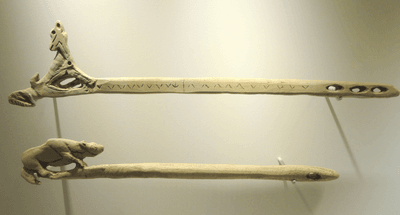


For decades, archaeologists have assumed that members of the Palaeoindian Clovis culture used a weapon called an atlatl to hunt mammoth and other beasts. However, new research indicates that the device probably didn’t appear in the Americas until several millennia after the Clovis disappeared.
The first cultural complex to spread across North America, the Clovis are thought to have occupied the region between about 13,340 and 12,710 years ago. Generally perceived as big game hunters, this ancient population is thought to have utilized atlatls as their primary weapon.
Consisting of a handheld rod with a hook at one end, an atlatl is essentially a propulsion device that can be used to launch a dart at high velocity and over a long range. It’s therefore believed that the use of atlatls allowed the Clovis to kill dangerous animals from a safe distance, thus minimizing a hunter’s chance of being injured by their enormous prey.
On top of that, atlatls are seen as “equalizers”, in the sense that they enabled smaller or weaker individuals to hunt with the same efficiency as the strongest members of a group.
However, no preserved atlatls have ever been discovered at Clovis sites, and the 10 oldest known examples in the Americas date to between 9,300 and 6,100 years ago. Using statistical modeling, the authors of a new study suggest that the earliest appearance of the weapon in North America was probably 9,996 years ago.
You have hunter-gatherer groups on different continents who are facing similar problems, so they come to similar solutions.
Professor Metin Eren
“In addition to the fact that we've never found a [Clovis] atlatl, our statistical results show that there's a 4,000-year gap between [the disappearance of the Clovis and] the earliest predicted atlatl,” said study author Professor Metin Eren from Kent State University. “That’s not even close,” he told IFLScience.
According to the researchers, these findings re-write our understanding of Clovis hunting technologies and strategies. For example, if they weren’t slinging atlatl darts around, then they may have used javelins or thrusting spears – both of which would have required hunters to get much closer to their targets.
This, in turn, increases the chance of suffering serious hunting injuries, although it may also have brought certain advantages, as both spears and javelins have been shown to deliver higher kinetic energy impacts than atlatl darts. For now, however, the exact weapon systems used by the Clovis remain the subject of speculation.
“The point is, we have no idea what the hell they were using,” says Eren.
Amidst this uncertainty, however, the new study shines a spotlight on a fascinating phenomenon known as technological convergent evolution, whereby separate human populations invent the same tools independently of one another. The atlatl is known to have existed in Palaeolithic Eurasia, yet its relatively recent appearance in the Americas suggests that it was not brought to the continent by the earliest humans to cross over from the Old World.
Instead, the atlatl was invented independently in the Americas, with no contact between its hunter-gatherer creators and those that had already devised the weapon in other parts of the world.
“Convergent evolution is remarkably common, both in biological and cultural evolution,” says Eren. “You have hunter-gatherer groups on different continents who are facing similar problems, so they come to similar solutions.”
“In that sense, it's kind of neat to propose that the atlatl in North America was its own independent thing,” he says.
The study is published in the Proceedings of the National Academy of Sciences.